
When to Split vs Consolidate Orders in Omnichannel Fulfillment
When fulfilling orders with multiple items, the key decision is whether to split shipments (send items from multiple locations) or consolidate shipments (combine items into one package). This choice impacts costs, delivery speed, and customer satisfaction. Here's the quick breakdown:
- Splitting Orders: Necessary when items are in different locations, urgent delivery is required, or certain products need special handling. Downsides include higher shipping costs ($19–$30 extra per split) and potential customer confusion.
- Consolidating Orders: Reduces costs, packaging waste, and improves customer experience. Works best when items are available in one location or when delivery windows allow extra time for grouping.
Factors to consider:
- Inventory Location: Strategic placement of top-selling items can reduce splits.
- Shipping Costs: Splits add surcharges, packaging, and operational expenses.
- Delivery Speed: Tight SLAs may require splitting to meet deadlines.
- Customer Preferences: Most customers prefer single-package deliveries.
Automation tools like Navexa help optimize these decisions by analyzing inventory, shipping costs, and delivery timelines in real-time, ensuring a balance between cost efficiency and customer satisfaction.
Backordering & Split Shipments | Unleashed Inventory Management Training Academy
sbb-itb-ed0a9d1
Key Factors for Deciding Between Splitting and Consolidating Orders
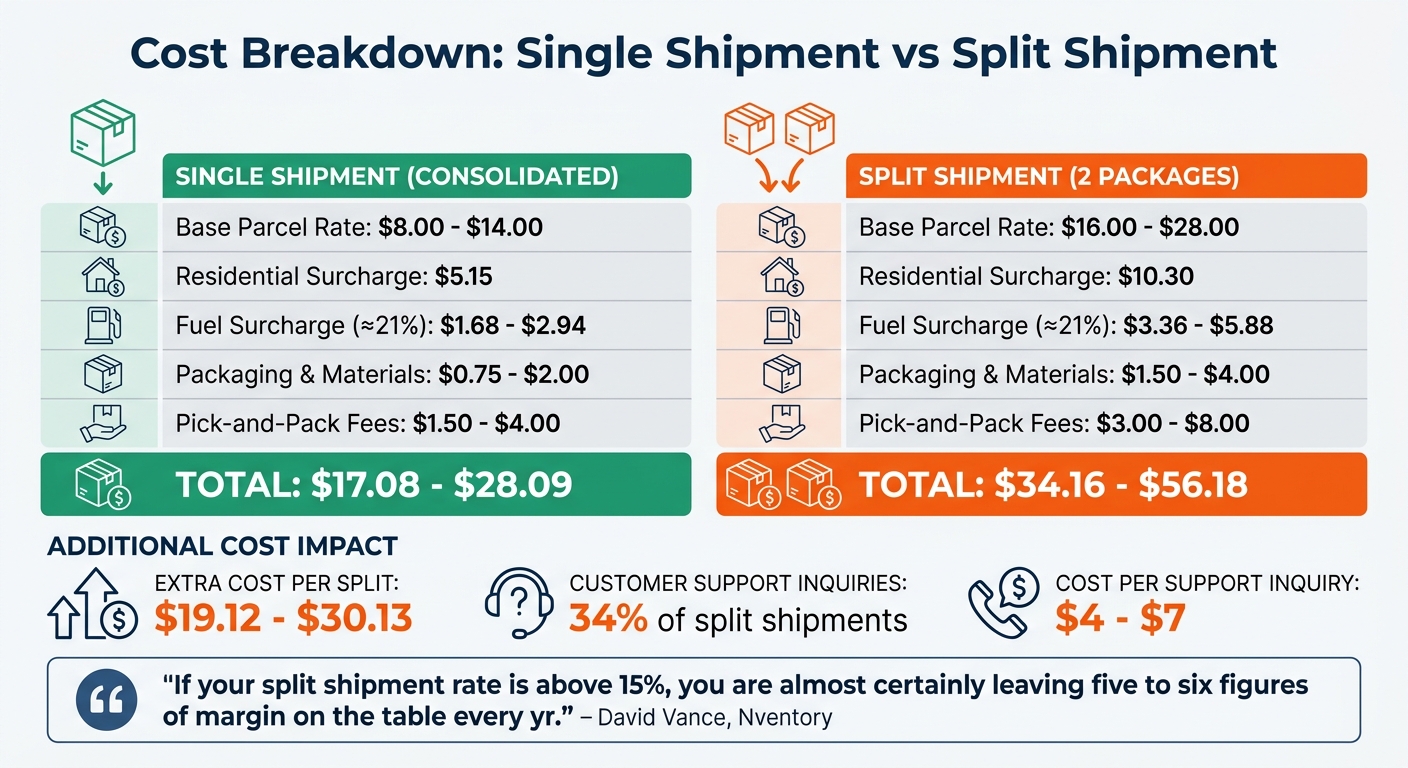
Cost Comparison: Consolidated vs Split Shipments in Omnichannel Fulfillment
Deciding whether to split or consolidate orders is no simple task. It hinges on four main factors: inventory location, shipping costs, delivery speed, and customer expectations. Balancing these elements is crucial for a smooth omnichannel fulfillment strategy.
Inventory Availability
Order splitting often happens because items are stored in different locations. For instance, if a customer orders SKU A from the East Coast and SKU B from the West Coast, splitting becomes unavoidable unless inventory is transferred. This geographic imbalance is one of the leading causes of split shipments.
To minimize splits, consider strategic inventory placement and inventory forecasting. Stock fast-moving "A" items - your top sellers - at all fulfillment centers to reduce the need for splits. On the other hand, slower-moving "C" items can be centralized in fewer locations. For non-urgent orders, holding them for 24–48 hours can allow time to consolidate items from different velocity categories.
Another helpful approach is analyzing SKU pairs that are frequently ordered together. For example, if 15–20% of orders include both Product X and Product Y, storing these items together at high-volume nodes can prevent unnecessary splits. Pre-assembled bundles can also simplify fulfillment by grouping items under a single SKU, unlike virtual kits, which require picking components from separate locations.
But inventory location is just one piece of the puzzle - shipping costs are another major factor.
Shipping Costs
Splitting orders can significantly increase shipping expenses. Each split adds duplicate charges for base rates, surcharges, fuel, packaging, and pick-and-pack fees. On top of that, there's the risk of customer support costs: about 34% of customers contact support over a "missing" package, adding $4–$7 per inquiry. Altogether, the cost of a split shipment can range from $19.12 to $30.13.
| Cost Component | Single Shipment (Consolidated) | Split Shipment (2 Packages) |
|---|---|---|
| Base Parcel Rate | $8.00 - $14.00 | $16.00 - $28.00 |
| Residential Surcharge | $5.15 | $10.30 |
| Fuel Surcharge (≈21%) | $1.68 - $2.94 | $3.36 - $5.88 |
| Packaging & Materials | $0.75 - $2.00 | $1.50 - $4.00 |
| Pick-and-Pack Fees | $1.50 - $4.00 | $3.00 - $8.00 |
| Total Estimated Cost | $17.08 - $28.09 | $34.16 - $56.18 |
"If your split shipment rate is above 15%, you are almost certainly leaving five to six figures of margin on the table every year." – David Vance, Nventory
To control costs, set a threshold in your routing system. For example, authorize splits only if consolidating would cost at least $12–$15 more.
Of course, shipping costs aren't the only consideration - delivery speed and SLAs also play a big role.
Delivery Speed and SLA Requirements
Service Level Agreements (SLAs), like 2-day or overnight delivery, often dictate whether splitting is necessary. If a single warehouse can't meet the promised delivery timeframe, splitting becomes essential to ensure the order arrives on time. For standard delivery windows (3–5 days), there's more leeway. In these cases, holding orders for 24–48 hours may allow time to transfer items to a single location without breaking the SLA. Identifying and addressing SLA "dead zones" can also help refine delivery promises at checkout.
SLAs, therefore, act as a deciding factor in whether consolidation is possible or splitting is unavoidable.
Customer Expectations and Preferences
Customer experience matters - a lot. Most customers (9 out of 10) prefer receiving their entire order in a single package rather than in multiple shipments. Splitting orders often leads to a 12–18 point drop in Net Promoter Score (NPS) compared to consolidated shipments.
That said, some customers prioritize speed over receiving everything in one box. Express delivery shoppers, for example, might accept split shipments if it guarantees faster arrival. The key is transparency: let customers know during checkout if their order might arrive in multiple packages, rather than surprising them after the fact.
Balancing speed, cost, and expectations is the foundation of an effective fulfillment strategy.
When to Split Orders
Splitting orders can increase both costs and complexity, but there are situations where it makes sense. Factors like inventory location, shipping costs, and delivery speed often play a role in determining whether splitting is the right choice. Below are some common scenarios where splitting orders becomes necessary.
Scenarios Favoring Order Splitting
Partial stockouts are a frequent reason for splitting orders. If only some items in an order are available, shipping those immediately can prevent cancellations and maintain customer trust. This ensures customers receive part of their order on time, capturing revenue that might otherwise be lost.
Distributed inventory often makes splitting unavoidable. For instance, if one item is stored in a warehouse on the East Coast and another is only available on the West Coast, shipping directly from each location is usually faster and more cost-effective than transferring stock between warehouses. However, splitting should only occur if the cost of consolidation outweighs the added expense of separate shipments.
Urgent delivery commitments may also require splitting. If a customer opts for 2-day shipping and only certain items can meet that timeframe from a specific warehouse, splitting ensures delivery promises are kept. Shipping from the closest location minimizes transit time, even if other items arrive later from a different source.
Specialized handling requirements justify splits in cases where certain items need unique shipping methods. For example, bulky or heavy goods might require a specialized carrier, while smaller items can ship via standard ground services. Though this approach may increase costs, it can still be more efficient overall.
| Scenario | Pros | Cons |
|---|---|---|
| Partial Stockout | Prevents order cancellations; meets delivery expectations for available items | Higher shipping and packaging costs for additional shipments |
| Distributed Stock | Reduces delays by avoiding warehouse transfers | Multiple tracking numbers may confuse customers |
| Heavy/Bulky Items | Enables cost-efficient shipping using specialized carriers | Increases pick-and-pack fees and surcharges |
| Urgent SLAs | Keeps delivery promises by reducing transit time | Greater environmental impact from multiple shipments |
| Dropship Items | Expands product offerings without holding all inventory | Limited control over third-party packaging and delivery timing |
Dropshipping arrangements often lead to split shipments, especially when some items come from third-party suppliers while others ship from your own inventory.
Customer-driven requests can also necessitate splits. For example, gift orders sent to multiple addresses or customers choosing to receive available items sooner at checkout both require separate shipments. In such cases, the customer has already agreed to the split, reducing potential concerns about the experience.
These scenarios highlight when splitting orders is a practical solution, paving the way for a discussion on when consolidating shipments might be the better choice.
When to Consolidate Orders
Consolidating orders can be a smart move when the circumstances align, offering both cost savings and operational benefits. For instance, if all items in an order are available at a single warehouse - even if it’s not the closest one - shipping from that location can often be cheaper than splitting the order across multiple, nearer warehouses.
Another ideal scenario for consolidation is when certain products are frequently purchased together. These paired items, which appear in 15–20% of multi-item orders, should ideally be stored at the same fulfillment center. By using tools like market basket analysis to identify and co-locate these items, businesses can reduce split rates by as much as 30–45%.
Cost Considerations for Consolidation
Consolidation makes the most sense when the cost of a single shipment is lower than the combined expenses of splitting an order. Splitting orders often triggers additional charges, such as:
- Duplicate residential surcharges (around $5.15 per package)
- Extra fuel surcharges
- Additional packaging materials, costing $0.75–$2.00 per package
- Increased pick-and-pack fees, ranging from $1.50–$4.00 per package
Altogether, one split can add between $19.12 and $30.13 in extra costs. Beyond the financial impact, consolidation supports environmental goals by cutting shipments and reducing CO2 emissions by 20–40% per parcel.
"A single-box delivery beats two separate deliveries in 9 out of 10 customer satisfaction scenarios, and you avoid the added cost and complexity of a split." – David Vance, Operations Expert, Nventory
Best Practices for Order Consolidation
Certain strategies make consolidation more effective:
- Virtual Kits and Bundles: Ship these items together in one package and allow a 24–48 hour window for slower-moving products to join the shipment without delaying delivery.
- Standard Shipping Tiers: Orders with 3–5 day delivery windows provide the flexibility needed for consolidation, unlike express orders that prioritize speed. This approach can cut carrier costs by 28–35% and improve on-time delivery rates by about 6 percentage points.
Consolidation doesn’t just save money - it also improves customer satisfaction. Single-package deliveries often lead to a 12–18 point higher Net Promoter Score compared to split shipments. Additionally, about 34% of customers receiving split deliveries contact customer service, with each interaction costing $4–$7.
| Metric | Impact of Consolidation |
|---|---|
| Carrier Spend | 28–35% Reduction |
| CO2 per Parcel | 20–40% Reduction |
| Handling Time | 15–20% Reduction |
| On-Time Delivery | ~6% Improvement |
| Total Landed Cost | 10–25% Reduction |
Source: Compiled from industry data
Implementing Consolidation Strategies
To make consolidation work, configure your Order Management System to prioritize single-location fulfillment. Set a split penalty of $15–$20 in your routing logic, allowing splits only when single-location fulfillment exceeds this cost. For non-express orders, consider hold-and-consolidate windows of 12–48 hours to group all items into one shipment.
Aim to keep split rates below 10% for standard assortments, with top-performing operations maintaining rates under 5%. If your split rates exceed 15%, you’re likely losing significant margin annually. Achieving optimal rates requires forward-stocking frequently paired items at the same locations and using standardized packaging and box sizes to minimize dimensional weight penalties and improve cost accuracy.
How Navexa Optimizes Split and Consolidate Strategies
Navigating the complexities of order routing and allocation can be daunting, but Navexa simplifies the process with smart automation tools. Deciding when to split or consolidate orders no longer needs to rely on manual calculations. By leveraging data from multiple carriers, inventory locations, and cost factors, Navexa streamlines these decisions, making them faster and more efficient.
Multi-Carrier Rate Shopping and Real-Time Analytics
Navexa's platform compares shipping rates from major carriers in real time, factoring in costs from various warehouses. When an order is placed, the system evaluates whether it's more cost-effective and time-efficient to ship everything from one fulfillment center or to split the items across multiple locations.
A standout feature is its intelligent box optimization, which uses 3D bin packing simulations. This helps determine if consolidating items into a single box would lead to higher dimensional weight charges or if splitting shipments would save money instead.
The analytics dashboard offers detailed insights, such as cost-per-order breakdowns and historical savings trends. This transparency helps businesses understand how their fulfillment strategies affect their bottom line. With over 50 million packages processed for 2,500+ brands, Navexa has demonstrated its ability to handle high-volume operations.
"Navexa reduced our shipping costs by 12% in the first month, with box optimization paying for the platform." – Sarah Chen, Head of Operations, Bloom & Wild
Automated Workflows and Inventory Forecasting
Beyond rate shopping, automation is key to optimizing inventory management. Navexa eliminates manual decision-making by applying custom rules based on real-time data. Its inventory forecasting tools predict demand patterns and seasonal trends, ensuring stock is positioned where it's needed most.
This predictive capability has significantly reduced stockouts - by as much as 40% - minimizing the need for order splitting due to inventory shortages at primary warehouses.
"The inventory forecasting feature helped us reduce stockouts by 40%. Our customers are happier than ever." – Emily Watson, Founder & CEO, Glow Recipe
Benefits of Using Navexa
By integrating multi-carrier rate shopping, box optimization, and inventory forecasting, Navexa helps businesses cut shipping costs by an average of 10-15% while improving delivery times. The platform automates tasks like carrier selection and label printing, saving teams from tedious manual work.
With compatibility across 50+ e-commerce platforms - including Shopify, WooCommerce, and Amazon - Navexa’s solutions fit seamlessly into existing systems, ensuring businesses can optimize without needing a complete tech overhaul.
The result? Lower costs, quicker fulfillment, and happier customers.
Conclusion: Balancing Cost, Speed, and Customer Expectations
Deciding between splitting or consolidating orders is never a straightforward choice. It hinges on factors like inventory availability, shipping expenses, delivery timelines, and what customers expect. While splitting shipments can sometimes speed up delivery, it comes at a notable cost.
Split shipments tend to increase operational expenses and can negatively impact customer satisfaction. This becomes even more challenging for businesses handling hundreds or thousands of orders daily, as the added friction can quickly affect margins and service ratings.
Achieving efficient fulfillment starts with clear priorities. For example, creating a routing hierarchy that considers inventory levels and service-level agreements (SLAs) first, and then factors in order type alongside cost versus speed, is a smart strategy. Many companies implement a "split penalty threshold" of around $15–$20, ensuring that orders are only split when fulfilling from a single location would be significantly more expensive. These strategies lay the groundwork for automation in fulfillment processes.
Automation platforms like Navexa simplify these complex decisions. Instead of relying on manual calculations to determine costs across warehouses and carriers, Navexa uses real-time data to evaluate all options. It considers factors like dimensional weight penalties, carrier surcharges, and inventory positioning. This approach allows brands to cut shipping costs by 10–15% while also improving delivery times. By leveraging automation and data-driven insights, businesses can strike a better balance between operational costs and keeping customers happy.
FAQs
What split-rate percentage is too high?
A split-rate percentage above 15% is typically considered excessive. It can lead to considerable margin losses, sometimes amounting to five or six figures each year. Reducing split shipments is a smart way to cut costs and boost the efficiency of your fulfillment processes.
How long should I hold an order to consolidate it?
There isn’t a universal rule for how long you should hold an order to consolidate it. Instead, it depends on factors like inventory availability, shipping costs, and delivery speed. The best approach will vary based on your specific operations and what your customers expect. Striking the right balance between operational efficiency and prompt delivery is key when deciding whether to consolidate orders.
How do I set a split-penalty threshold in my OMS?
When configuring your Order Management System (OMS), setting a split-penalty threshold helps reduce unnecessary order splits. This involves defining rules or KPIs that balance costs and operational efficiency.
For instance, you can establish thresholds based on acceptable shipping costs - say, between $10 and $15 per split - or limit the maximum number of splits per order to two. Once these limits are in place, your OMS can be programmed to consolidate or reroute orders automatically if the thresholds are exceeded. This ensures smoother operations while keeping costs in check.
Ship your next order through Navexa.
Connect a store, buy a label, and see the numbers yourself.