
Real-Time Tracking: Benefits for E-Commerce Customers
Real-time tracking has transformed how customers follow their packages. It provides continuous updates, accurate delivery times, and transparency, which 71% of shoppers say makes them more likely to return to a retailer. Businesses benefit too, with fewer customer service inquiries, reduced failed delivery costs (averaging $17.20 per order), and smarter logistics through technologies like GPS, RFID, and AI-powered predictions.
Key Takeaways:
-
For Customers:
- Live updates reduce delivery anxiety and missed packages.
- Features like electronic proof of delivery (photos, timestamps) boost trust.
- Self-service reduces the need to contact support.
-
For Businesses:
- Fewer "Where’s My Order?" inquiries free up resources.
- AI improves delivery routes, saving time and fuel.
- Tools like Navexa cut shipping costs by 10-15% and streamline workflows.
Real-time tracking isn’t just a feature - it’s a necessity for modern e-commerce. Customers gain clarity, and businesses see cost savings and efficiency improvements.
How Does Real-Time Shipment Tracking Work?
sbb-itb-ed0a9d1
Problems with Older Tracking Systems
Before real-time tracking became the norm, traditional systems often left both businesses and customers guessing. These older methods relied on barcode scans at specific checkpoints - like when a package arrived at or departed from a sorting facility. The result? Long periods where no one knew the exact location of a parcel, creating frustrating "mystery gaps".
"Historically, parcel tracking offered only sporadic status updates - often delayed or inaccurate - leading to consumer frustration and elevated customer service inquiries." - Postman.Live
Limited Shipment Visibility
Older tracking systems only captured a package's location when a barcode was scanned, providing static updates at major points in the delivery process. This left logistics teams without live insights, forcing them to react to problems like traffic jams or bad weather after they had already caused delays.
Another drawback was the lack of digital proof of delivery. Electronic confirmations - like photos, geotags, or timestamps - were rarely collected. This made it challenging to resolve disputes when customers reported missing packages, further complicating the delivery process.
Customer Frustration from Delayed Updates
Delayed or incomplete tracking updates caused significant frustration for customers. When they couldn't get accurate or timely information about their orders, it left them feeling uncertain and dissatisfied. Transparency plays a huge role in building trust, and sporadic updates often gave the impression of poor service.
This lack of clarity led to an increase in "Where Is My Order" (WISMO) inquiries - one of the biggest headaches for e-commerce businesses. Instead of enjoying their shopping experience, customers found themselves chasing down information that should have been readily available.
Business Inefficiencies
While customers dealt with the stress of delayed updates, businesses faced their own challenges. The flood of WISMO inquiries overwhelmed customer service teams, requiring them to spend hours answering repetitive questions. Companies that moved to modern tracking systems saw a 30% drop in these inquiries, freeing up resources for other priorities.
Without real-time tracking, businesses also struggled to identify delivery bottlenecks, monitor carrier performance, and streamline their routes. This reactive approach often hurt customer satisfaction and, ultimately, the bottom line.
How Real-Time Tracking Closes Visibility Gaps
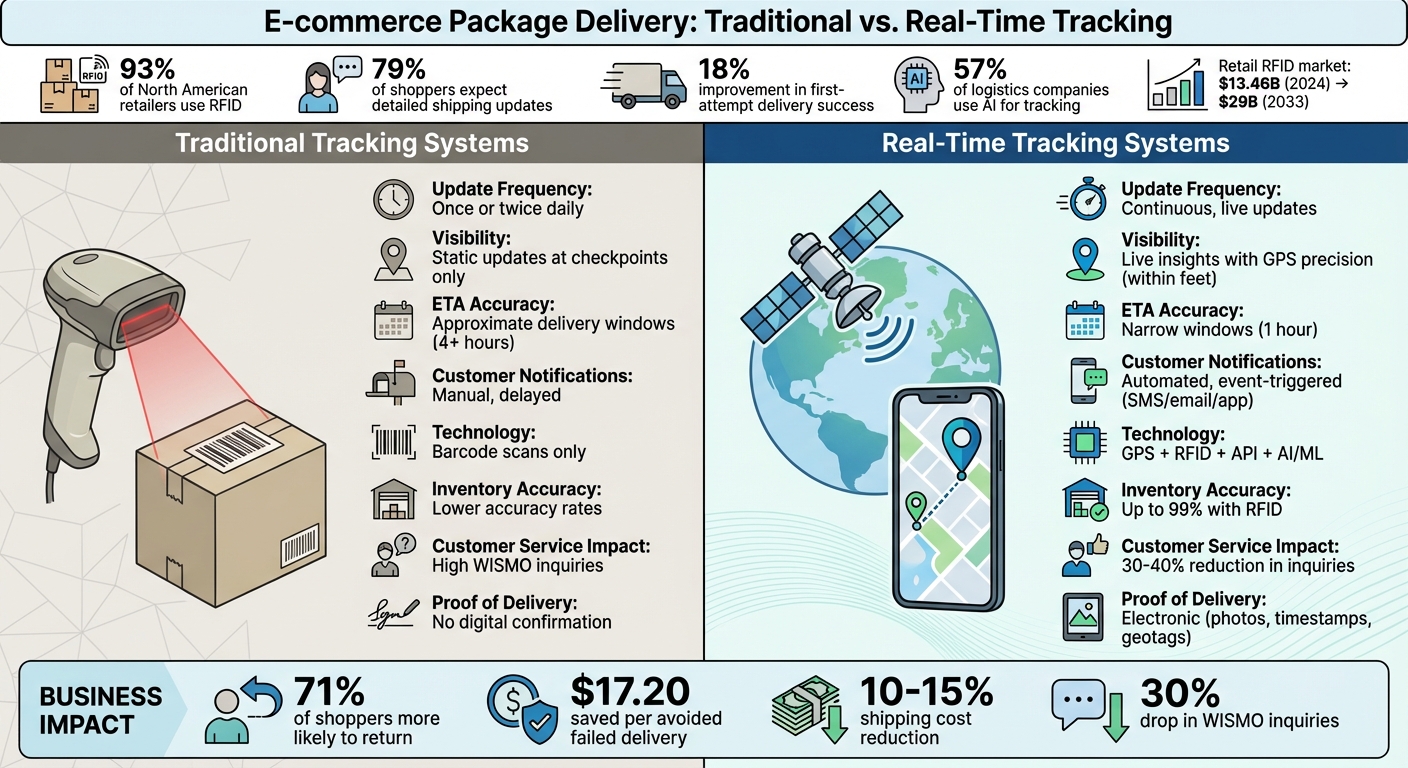
Traditional vs Real-Time Package Tracking: Key Differences and Benefits
Real-time tracking bridges the gaps left by older systems by combining technologies like GPS, RFID, and API integrations. The result? Continuous, precise updates that eliminate barcode scan delays and provide live insights about package locations and arrival times. These advancements enhance both customer satisfaction and business operations.
GPS and RFID Technologies
GPS handles the "big picture" by offering real-time tracking of vehicles and shipments, accurate to within feet. This allows businesses to monitor routes, anticipate delays, and adjust shipments as needed. Meanwhile, RFID focuses on the details, tracking individual items or pallets without requiring a direct line of sight. For example, UHF RFID tags - the standard in retail - can scan hundreds of items at once from up to 40 feet away.
Take Selmark, a Spanish lingerie brand, as an example. In March 2024, they implemented a UHF RFID tagging system under the leadership of Director of Innovation Diego Piñeiro. This change, which encoded unique IDs at the manufacturing stage, increased their picking and dispatch efficiency by 30%. Similarly, Lululemon rolled out Nedap's iD Cloud RFID platform across over 600 stores globally in late 2025. Carl Barker, their VP of Global Omni Programs, spearheaded this initiative to improve product availability through real-time inventory tracking.
RFID isn't just about efficiency - it’s also about accuracy. With inventory accuracy rates reaching up to 99%, RFID is now used by 93% of North American retailers in some capacity. The retail RFID market, valued at $13.46 billion in 2024, is expected to grow to $29 billion by 2033.
API Integrations for Live Tracking
APIs act as the glue connecting e-commerce platforms, carriers, warehouses, and last-mile delivery networks. They pull data from various sources - like telematics, driver apps, and port systems - and consolidate it into a single, real-time dashboard.
Thanks to APIs, automated workflows can send proactive notifications (via SMS, email, or app alerts) based on key tracking events like "Order Picked Up" or "Out for Delivery". This matters because 79% of online shoppers expect detailed updates throughout the shipping process. Enhanced visibility not only meets customer expectations but can also cut customer service inquiries by up to 40%.
Traditional tracking systems offer limited updates - often just once or twice a day - with approximate ETAs. In contrast, API-powered real-time tracking provides continuous updates, dynamic ETAs, and event-triggered notifications. Customers can even reschedule deliveries, reroute packages, or report issues in real time. These updates also feed into predictive analytics, sharpening delivery estimates even further.
Predictive Delivery Estimates
Predictive algorithms take tracking to the next level by using AI and machine learning to analyze historical data, optimize routes, and respond to real-time conditions like traffic or weather. Instead of vague delivery windows, customers receive increasingly accurate time estimates - shifting from a broad 4-hour window to a much narrower 1-hour window.
This level of precision reduces delivery anxiety and helps customers plan their day more effectively. It also benefits businesses: predictive notifications can improve first-attempt delivery success rates by 18% for large retailers, ensuring someone is home when the driver arrives. Over 57% of logistics companies now rely on AI to process GPS and sensor data, enabling smarter, more efficient operations.
"Real-time tracking data influences consumer preferences for delivery time windows, preferred drop-off locations, and even courier choice."
- Jordan Casey, Senior Editor, Postman.live
Benefits of Real-Time Tracking for Customers
By bridging the gaps left by traditional tracking systems, real-time tracking takes the delivery experience to a whole new level. It shifts the process from guesswork to clarity, giving customers full visibility into their orders - from the moment they ship to when they arrive at the doorstep.
Better Customer Satisfaction
Real-time tracking allows customers to plan around accurate delivery times, reducing stress and avoiding missed deliveries. Today, shoppers expect this level of transparency, and many specifically choose retailers that offer it. Automated updates at key milestones mean customers don’t have to manually check their orders, making the process seamless.
Failed deliveries can cost retailers an average of $17.20 per order. Advanced tracking tools help sidestep these losses by providing precise ETAs, ensuring someone is available to receive the package. Features like electronic proof of delivery, complete with photos and timestamps, further reassure customers that their orders have been delivered correctly.
This kind of reliability naturally builds deeper trust in the retailer's service.
Increased Trust Through Transparency
Trust is key to keeping customers coming back, and transparency plays a big role in earning that trust. When customers can track their orders every step of the way, they feel confident that the retailer has a strong grip on the fulfillment process. In fact, 85% of consumers say they’re more likely to shop again with a retailer that offers detailed tracking throughout the delivery journey.
"In a world where speed and transparency reign supreme, the ability to track your parcels in real time is more than a logistics feature - it's a brand promise." - Detrack
Even when delays occur, timely updates help maintain customer confidence. Whether the issue is weather, traffic, or customs-related, proactive alerts with revised delivery estimates show professionalism and reliability.
Fewer Customer Service Inquiries
Real-time tracking empowers customers to get the answers they need without contacting support. By enabling self-service, businesses can reduce customer service inquiries by up to 40%.
"Last mile tracking is win-win, as your business will benefit from reduced inbound and outbound calls. In this way, service representatives can focus on customers who really need a human conversation." - Descartes
With live updates addressing most concerns, customers feel more assured and need less assistance. This frees up service teams to handle more complex issues, enhancing the overall customer experience. And here’s the kicker: 89% of consumers are more likely to become repeat buyers after a positive customer service interaction. Real-time tracking not only improves efficiency but also fosters loyalty and encourages repeat business.
Business Benefits of Real-Time Tracking
Real-time tracking isn't just about keeping customers informed - it also brings substantial advantages to the businesses behind the scenes. While customers gain peace of mind from live updates, companies benefit from streamlined operations, reduced costs, and improved logistics efficiency. This dual impact makes real-time tracking a game-changer for e-commerce.
Lower Support Costs and Increased Efficiency
When customers can track their orders in real time, they’re less likely to contact support with "Where is my order?" (WISMO) inquiries. This self-service capability lightens the load on customer service teams, freeing them up to handle more complex issues. Additionally, tools like electronic proof of delivery (E-POD), which uses photos, timestamps, and geotags, help resolve disputes faster and protect businesses from false claims of non-receipt.
Logistics teams also gain instant awareness of delays. For example, if a driver is stuck in traffic or encounters bad weather, managers can quickly reroute nearby vehicles to keep things moving smoothly. This kind of agility helps prevent small issues from escalating into larger problems.
Smarter Routes, Lower Costs
Real-time tracking provides logistics teams with precise vehicle locations, enabling them to optimize delivery routes on the fly. Advanced systems powered by AI and machine learning go a step further, analyzing historical data to determine the most efficient routes and travel times. This not only cuts down on fuel consumption and vehicle emissions but also reduces unnecessary trips.
Technologies like RFID tags and barcode scanners add another layer of efficiency by offering detailed insights into package movement. They help minimize losses and prevent unauthorized access, ensuring that every package reaches its destination securely. These improvements pave the way for integrated platforms like Navexa to deliver even greater cost savings.
Cutting Costs with Navexa
Navexa takes real-time tracking to the next level by combining it with intelligent tools designed to save money. The platform reduces shipping expenses by 10–15% through features like multi-carrier rate shopping and smart analytics. For instance, Navexa compares rates across major carriers - USPS, UPS, FedEx, and DHL - and automatically selects the most cost-effective option for each shipment.
Another standout feature is intelligent box optimization, which analyzes product dimensions to pick the best box size. This reduces dimensional weight charges and helps cut down on packaging waste.
"In the first month of using Navexa, Head of Operations Sarah Chen reported a 12% reduction in shipping costs, noting that the intelligent box optimization feature alone covered the platform's cost." - Sarah Chen, Head of Operations, Bloom & Wild
The platform’s real-time analytics also allow businesses to spot delivery patterns and make smarter decisions about carriers and routes. As Marcus Rodriguez, VP of Logistics at Urban Outfitters, put it:
"We ship 10,000+ orders daily and Navexa handles it flawlessly. The multi-carrier rate shopping is a game-changer." - Marcus Rodriguez, VP of Logistics, Urban Outfitters
Using Real-Time Tracking with Navexa
Navexa takes the concept of real-time tracking and elevates it by combining it with tools designed to simplify e-commerce fulfillment. With a track record of shipping 50 million packages and supporting 2,500+ brands daily, Navexa proves its effectiveness in streamlining operations.
Real-Time Analytics for Smarter Decisions
Navexa’s dashboard consolidates key metrics like delivery times, carrier performance, and costs into a single, easy-to-navigate interface. This centralized view helps businesses spot trends - such as which carriers are faster in specific regions - and make informed decisions. Plus, its inventory forecasting feature uses advanced algorithms to predict stock needs and automate reorder points.
Emily Watson, Founder & CEO of Glow Recipe, shared her experience:
"The inventory forecasting feature helped us reduce stockouts by 40%. Our customers are happier than ever".
By aligning real-time tracking data with inventory levels, businesses can achieve smoother fulfillment workflows and better synchronization across operations.
Integrations with 50+ Platforms
Setting up real-time tracking with Navexa is simple, thanks to its one-click integration with over 50 e-commerce platforms, including Shopify, WooCommerce, and Amazon. This ensures seamless data synchronization across all sales channels, allowing businesses to connect their stores in just minutes. With 99.9% uptime, Navexa guarantees reliable tracking information flow between e-commerce platforms and shipping carriers. For businesses with specific needs, custom API access provides a single dashboard to manage multi-carrier shipments efficiently.
Automation and Workflow Streamlining
Navexa’s automation capabilities take routine tasks off your plate. Businesses can set rules to automatically choose carriers, print labels, and send tracking updates to customers as soon as labels are created. The platform even extends automation to handle international shipping requirements like customs and duties. This level of efficiency makes Navexa particularly well-suited for high-volume operations, ensuring timely updates and smooth workflows.
Conclusion
Real-time tracking has grown from a simple convenience to a core feature of e-commerce. With 71% of consumers more likely to shop again and 85% inclined to return when they can track their deliveries, it’s clear that visibility plays a big role in customer satisfaction. When customers can see exactly where their package is and when it will arrive, their stress decreases, and their trust in the business increases.
For businesses, the benefits go beyond happy customers. Real-time tracking slashes support costs by reducing "Where’s my order?" inquiries, giving logistics teams the ability to reroute drivers and handle delays instantly. It also helps avoid the average $17.20 loss per failed delivery. Features like route optimization cut fuel use and vehicle wear, while electronic proof of delivery protects against false claims.
"Transparency = trust. If customers can see that you've got a tight handle on their deliveries, they're more likely to return - and recommend you to others."
- Detrack
Navexa takes these advantages further by combining them into a comprehensive fulfillment system. It offers tools like multi-carrier rate shopping, smart box optimization, inventory forecasting, real-time analytics, and integrations with over 50 platforms. With support for international shipping and automated workflows, it’s designed to make fulfillment seamless and scalable.
FAQs
How does real-time tracking actually work?
Real-time tracking keeps tabs on a shipment's location and status as it moves through the supply chain. Using technologies like GPS, RFID, and IoT sensors, data is collected at multiple points and sent to a central platform. This allows customers and businesses to view live updates - such as current location, estimated delivery times, and any delays - via intuitive dashboards. The result? Better transparency, fewer customer support calls, and smoother logistics operations.
What should I do if my tracking shows a delay or stops updating?
If your tracking system experiences delays or stops providing updates, try integrating real-time tracking platforms that connect via APIs to your shipping partners. This can provide quicker and more accurate updates. Additionally, implement automated notifications to proactively inform customers about their shipment status. These measures can help maintain transparency and minimize customer frustration during shipping delays.
How does real-time tracking help prevent lost or stolen packages?
Real-time tracking significantly boosts package security by offering continuous updates on shipment locations. This constant monitoring helps businesses identify potential problems early, allowing them to act swiftly to prevent loss or theft. With improved visibility, it minimizes delivery mistakes and provides customers with a more dependable shipping experience.
Ship your next order through Navexa.
Connect a store, buy a label, and see the numbers yourself.