
How Real-Time Carrier Rate Monitoring Reduces Shipping Costs
Shipping costs can drain profits, but real-time carrier rate monitoring can cut costs by up to 15%. This system automates the process of comparing live shipping rates from carriers like USPS, FedEx, UPS, and DHL, ensuring you always choose the most cost-effective option. It factors in package details, destination, and hidden fees like fuel surcharges or dimensional weight charges, saving time and money.
Key Benefits:
- Save 10–15% on shipping costs by finding the best rates instantly.
- Eliminate errors from manual rate selection and outdated data.
- Speed up order processing with automated workflows and live pricing.
- Optimize packaging to reduce dimensional weight charges.
For example, Bloom & Wild reduced shipping costs by 12% in just one month using Navexa, a real-time monitoring platform. Businesses shipping thousands of orders daily find this system indispensable for cutting costs and improving efficiency.
If you're still relying on manual rate selection, it's time to upgrade. Real-time monitoring doesn’t just save money - it simplifies shipping, reduces errors, and improves customer satisfaction.
3 Smart Ways to Reduce Rising Ecommerce Shipping Costs
sbb-itb-ed0a9d1
The Cost of Manual Carrier Rate Selection
At first glance, manual carrier selection might seem like a cost-effective approach. But relying on static rates and incomplete data often leads to consistent overpayment. Here’s a closer look at the common pitfalls and financial impact of this outdated method.
Common Problems with Manual Rate Selection
One major issue is the "apples-to-oranges" problem. Shippers frequently compare a carrier's base rate with another carrier's total cost, without factoring in additional fees like fuel surcharges, residential delivery fees (which range from $6.55 to $6.75 per package), or address correction charges. Anurag Allena from Shipium explains this misstep perfectly:
"One of the most significant errors a shipper can make is comparing one carrier's base rate to another's total cost. It's the classic apples-to-oranges problem."
Another costly mistake comes from Dimensional Weight (DIM) errors. Estimates for package dimensions can inflate costs by 20–30%, with DIM overcharges affecting about 23% of packages. A lightweight but bulky package could end up costing five to ten times more than expected. Additionally, manual selection relies on static transit tables and routing guides that fail to account for real-world disruptions like weather delays, holiday surges, or carrier outages. This leaves shippers locked into carriers that may no longer provide the best rates or service.
Financial Impact of Poor Shipping Choices
Surcharges are becoming a bigger piece of the pie, now accounting for 25–40% of total parcel spend. Brandon Staton, Founder and CEO of ShipMint, highlights the importance of addressing these hidden costs:
"Surcharges now represent 25–40% of total parcel spend. That's not a rounding error. That's a line item that deserves the same scrutiny as your base transportation rates."
Ignoring fully loaded rates leads to an average overpayment of 6%. For enterprises spending $10 million annually on shipping, this translates to $600,000 in unnecessary costs. Even smaller businesses with $3 million in annual revenue lose an estimated $207,000.
The financial drain doesn’t stop there. Manual data entry comes with an error rate of roughly 3% per field. For an order with nine fields, there’s a 24% chance of at least one mistake. Each fulfillment error costs between $50 and $150 or more, factoring in wasted shipping, return labels, replacement shipments, and additional warehouse labor for inventory reconciliation. And the customer impact? A single poor delivery experience could deter 40% of buyers from making future purchases, directly cutting into customer lifetime value.
These challenges make it clear: real-time carrier rate monitoring is crucial for uncovering and addressing hidden shipping costs.
What Real-Time Carrier Rate Monitoring Solves
Real-time rate monitoring leverages API integration to pull live data from multiple carriers, eliminating the need for manual calculations. These systems compare costs, transit times, and service levels across major carriers like USPS, FedEx, UPS, and DHL in real time.
One major advantage is complete cost transparency. Real-time monitoring accounts for fully loaded rates, including fuel surcharges, residential delivery fees, and dimensional weight charges. This ensures you're comparing the total cost rather than just a base rate. By addressing the "apples-to-oranges" problem, businesses can achieve notable annual cost savings.
How Real-Time Monitoring Works
Manual carrier selection often leads to inefficiencies, but real-time monitoring tackles these challenges head-on.
Using direct API connections to carrier systems, the platform queries live carrier data as soon as an order is ready to ship. It retrieves current pricing based on package dimensions and destination, presenting options in seconds. The system also adapts dynamically to peak seasons or service disruptions, allowing seamless transitions between regional and national carriers without requiring contract renegotiations or routing guide updates. Advanced platforms even process carrier contracts simultaneously, delivering sub-second response times and avoiding warehouse delays.
This process enhances pricing accuracy, operational speed, and overall efficiency.
Main Benefits of Real-Time Monitoring
With dynamic rate comparisons, real-time monitoring offers three core benefits that directly reduce shipping costs:
- Instant Pricing: Access to Commercial Plus pricing and volume discounts in real time.
- Reduced Errors: Automated carrier selection eliminates human mistakes.
- Faster Processing: Orders are processed three times faster with automation.
| Feature | Manual Rate Selection | Real-Time Rate Monitoring |
|---|---|---|
| Speed | Slow, manual entry | Instant, API-driven |
| Carrier Access | Limited to 1–2 accounts | Multi-carrier (USPS, UPS, FedEx, DHL) |
| Accuracy | Prone to human error | Automated and data-driven |
| Cost | Standard retail/contract rates | Access to Commercial Plus pricing |
| Flexibility | Static and hard to adjust | Dynamic, real-time adjustments |
Businesses that implement multi-carrier rate shopping often cut shipping costs by 10–15% on average. Real-world examples highlight these savings:
"Navexa cut our shipping costs by 12% in the first month. The box optimization alone paid for the entire platform."
– Sarah Chen, Head of Operations, Bloom & Wild
"We ship 10,000+ orders daily and Navexa handles it flawlessly. The multi-carrier rate shopping is a game-changer."
– Marcus Rodriguez, VP of Logistics, Urban Outfitters
How Real-Time Monitoring Works in Practice
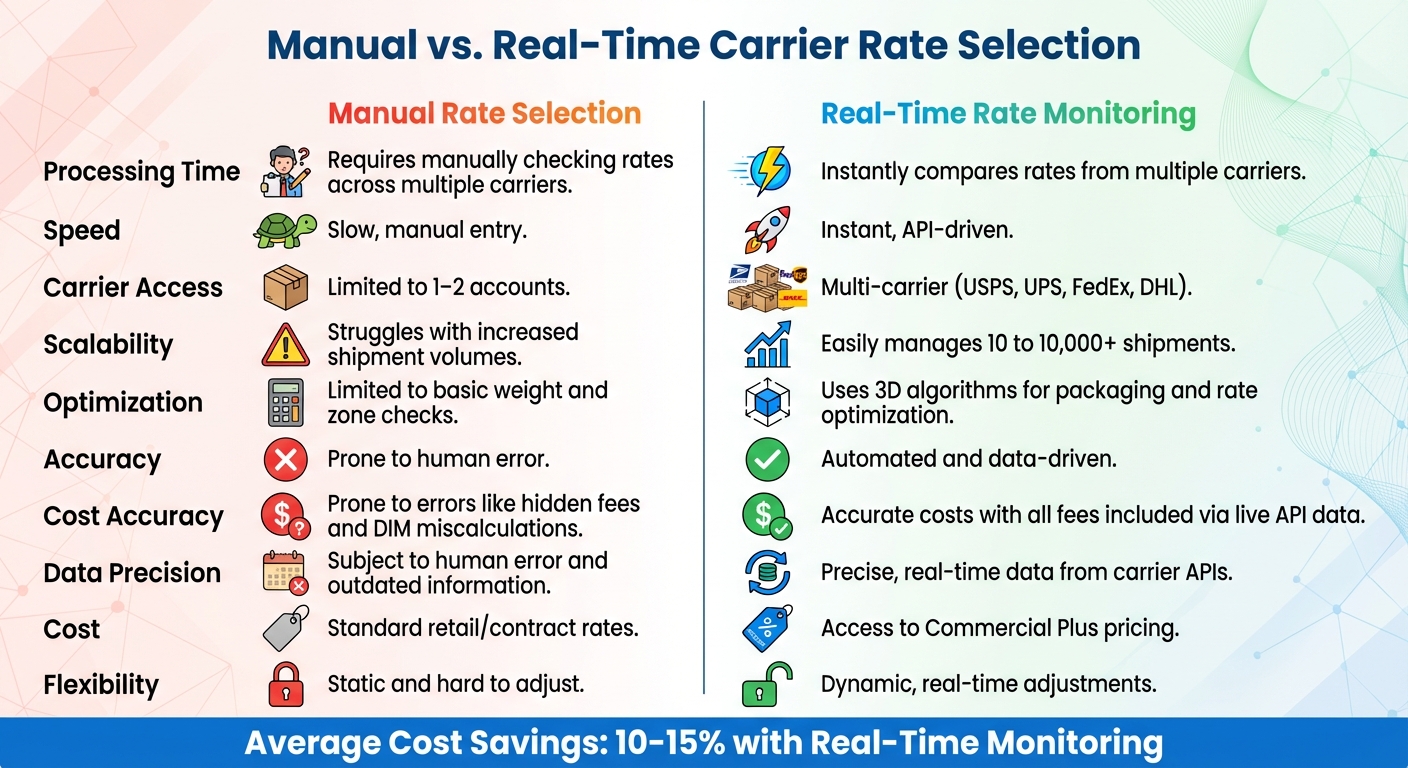
Manual vs Real-Time Carrier Rate Selection Comparison
Step-by-Step Process
When orders come in, the system automatically syncs shipment details - like origin, destination, weight, and dimensions. If item attributes for each SKU are provided, the system calculates the best rate quotes right away.
Before reaching out to carriers, the system uses 3D bin packing to determine the most efficient packaging. This step helps reduce DIM weight charges, which can significantly impact shipping costs. Once the packaging is finalized, the system connects directly to carrier APIs - like USPS, UPS, FedEx, and DHL - to pull live rate estimates based on the package's weight, size, distance, and count.
The platform then displays a side-by-side comparison of rates and delivery times. Users can either let the system automatically pick the best option - whether it’s the cheapest, fastest, or most reliable - or manually make a choice before purchasing and printing the shipping label with a single click. To avoid errors, integrated address validation ensures that incorrect data doesn’t lead to costly surcharges.
Some platforms also feature "Instant Rate" technology, which caches shipping cost data to speed up responses - delivering rates about one second faster than live API calls. These cached rates are impressively accurate, with 96% falling within 10 cents of live rates. For added precision, users can set an accuracy threshold (e.g., 5%), triggering live API calls if cached data exceeds the allowable deviation.
This step-by-step process demonstrates how automation simplifies what would otherwise be a complex and time-consuming task.
Comparison: Manual vs. Real-Time Rate Selection
The advantages of real-time monitoring become even clearer when compared to manual methods.
| Factor | Manual Rate Selection | Real-Time Monitoring |
|---|---|---|
| Processing Time | Requires manually checking rates across multiple carriers | Instantly compares rates from multiple carriers |
| Scalability | Struggles with increased shipment volumes | Easily manages shipments ranging from 10 to over 10,000 |
| Optimization | Limited to basic weight and zone checks | Uses 3D algorithms for packaging and rate optimization |
| Cost Accuracy | Prone to errors like hidden fees and DIM miscalculations | Provides accurate costs with all fees included via live API data |
| Data Precision | Subject to human error and outdated information | Relies on precise, real-time data from carrier APIs |
Implementing Real-Time Monitoring with Navexa
Navexa takes the concept of real-time monitoring and makes it even more efficient with a suite of integrated tools designed to cut costs and simplify shipping.
Navexa Features for Rate Monitoring
Navexa brings all the tools you need for tracking and optimizing carrier rates into one platform. It lets you instantly compare shipping costs across major carriers like USPS, FedEx, UPS, and DHL every time an order is placed, ensuring you don’t pay more than you should.
Its smart box optimization feature uses 3D bin packing to analyze your products and recommend the most efficient packaging. This feature directly addresses dimensional weight charges, which can quietly increase shipping costs. Additionally, the real-time analytics dashboard offers a clear breakdown of your cost-per-order, tracks savings trends over time, and provides actionable insights into your overall shipping expenses.
Navexa also allows you to automate workflows by setting custom carrier selection rules. For instance, you can program it to automatically choose USPS First Class for packages under 1 lb or prioritize the fastest shipping option for high-priority orders - all without manual effort.
US-Specific Benefits
For businesses in the United States, Navexa provides access to USPS Commercial Plus pricing, offering discounted rates well below standard retail prices. The platform integrates effortlessly with over 50 e-commerce platforms, including Shopify, Amazon, and WooCommerce, enabling real-time order synchronization with just one click.
Another standout feature is its automatic address validation, which catches errors during order processing. This prevents costly surcharges from issues like residential delivery misclassifications or address corrections. Navexa also speeds up order processing, handling tasks up to three times faster with batch operations and automated synchronization, making it a practical solution for businesses of any size.
These tailored features help businesses in the U.S. save money and operate more efficiently.
Cost Savings with Navexa
Navexa is all about measurable results. Users typically see a 10–15% reduction in shipping costs. To date, the platform has processed over 50 million packages for more than 2,500 brands. By combining smart rate comparisons with packaging optimization, businesses achieve an average 12% cost reduction.
The savings extend beyond shipping. Navexa’s inventory forecasting feature uses algorithms to predict demand and reduce stockouts. Emily Watson, Founder & CEO of Glow Recipe, shared that her company saw a 40% reduction in stockouts after adopting this tool.
Best of all, Navexa is free to use. Businesses only pay for shipping labels at discounted carrier rates, plus a small margin - there are no monthly fees or feature restrictions.
Proven Cost Reductions and Efficiency Gains
Measuring the Benefits
Real-time carrier rate monitoring helps businesses see exactly where they’re saving on shipping costs. By tracking metrics like shipping cost percentage, average cost per parcel, and surcharge rates, companies can uncover hidden fees and tackle inefficiencies head-on.
Industry leaders report savings of up to 12% while managing high order volumes seamlessly. Box optimization alone can cut costs by 5–10%, lowering package volume and DIM charges. Pair that with automated carrier selection, and businesses can process orders up to three times faster thanks to batch operations and smoother workflows. Take the example of a U.S.-based automotive parts provider: they slashed shipping costs by 23% - with 17% coming from time-in-transit optimization, 3–4% from better USPS rates, and 1–2% from integrating regional carriers.
What’s more, real-time monitoring isn’t just about cutting costs - it scales effortlessly as businesses grow and order volumes rise.
Scaling Operations with Real-Time Monitoring
Real-time monitoring doesn’t just save money; it also makes operations more efficient as order volumes climb. Automated tools like bulk label printing and carrier account management keep things running smoothly for businesses processing tens of thousands of orders daily. For instance, companies handling over 10,000 orders a day benefit from sub-second label generation and multi-threaded requests, boosting warehouse throughput.
Outside the warehouse, automation reduces manual entry and cuts picking errors by 40%, while speeding up packing by 35%. Emily Watson, Founder & CEO of Glow Recipe, used integrated inventory forecasting to slash stockouts by 40%, improving customer satisfaction significantly. Altogether, these operational upgrades can lead to a 20% increase in profit margins for e-commerce retailers.
Conclusion
Real-time rate monitoring is a game-changer for cutting shipping costs in e-commerce. By automatically comparing rates from USPS, FedEx, UPS, and DHL for every shipment, businesses can skip the guesswork and save both time and money. Plus, with intelligent box optimization, companies can see savings of 10–15%, giving their bottom line a noticeable boost.
But it’s not just about saving money - efficiency takes a huge leap as well. Automated workflows allow businesses to process orders three times faster, handle larger volumes without needing extra staff, and scale seamlessly as they grow. On top of that, automation reduces picking errors by 40% and speeds up packing by 35%, transforming how fulfillment is managed.
For businesses shipping thousands of orders daily, speed, accuracy, and cost savings aren’t optional - they’re essential. In fact, industry leaders have reported 12% cost reductions within the first month of implementing multi-carrier rate shopping, making it a must-have for high-volume operations managing over 10,000 orders a day.
Navexa combines all these tools into one powerful platform. From multi-carrier rate shopping and box optimization to inventory forecasting and integrations with over 50 platforms, it’s designed to grow alongside your business. With 99.9% uptime and support for international shipping, it ensures smooth operations at every stage.
Lower costs, faster processes, and happier customers - real-time rate monitoring is how today’s e-commerce businesses stay ahead of the competition.
FAQs
What fees does real-time rate monitoring include beyond the base rate?
Real-time rate monitoring might come with extra fees, including dimensional weight charges, surcharges, and service-specific fees. These additional costs depend on the carrier and the specific shipping conditions.
What order volume makes real-time rate monitoring worth it?
Real-time carrier rate monitoring proves incredibly useful for businesses managing large order volumes - think thousands of shipments every day. At this scale, investing in automation and rate comparison tools makes sense, as it can lead to major cost reductions and enhanced operational efficiency.
What data do I need to set up accurate real-time shipping rates?
To set up accurate real-time shipping rates, you’ll need to collect some essential details, such as the package weight, dimensions, and both the origin and destination addresses. One key factor to keep in mind is Dimensional (DIM) weight. Carriers often use this metric to calculate shipping costs, especially when the DIM weight is higher than the actual weight.
For precision, integrating carrier APIs is a smart move. These APIs provide live rate updates, taking into account things like fuel surcharges, discounts, and different service levels. This approach not only ensures accurate pricing but also helps you control costs and find the most budget-friendly shipping options.
Ship your next order through Navexa.
Connect a store, buy a label, and see the numbers yourself.