
How to Reduce Parcel Shipping Costs with Green Packaging
Want to cut shipping costs and reduce waste? Green packaging is the answer. By using eco-friendly materials and optimizing package sizes, businesses can save 20–30% on shipping expenses while meeting growing consumer demand for sustainable practices. Here's how:
- Right-sizing packages eliminates wasted space, reducing dimensional weight fees by up to 80%.
- Lightweight materials like Kraft paper, air pillows, and recycled mailers lower shipping costs without compromising protection.
- Durable options such as honeycomb paper and molded pulp provide strong, recyclable alternatives for fragile items.
- Technology tools like box optimization software and multi-carrier rate comparisons streamline fulfillment and cut costs by 10–15%.
With 72% of consumers prioritizing products with sustainable packaging, making these changes isn't just smart - it’s essential for staying competitive.
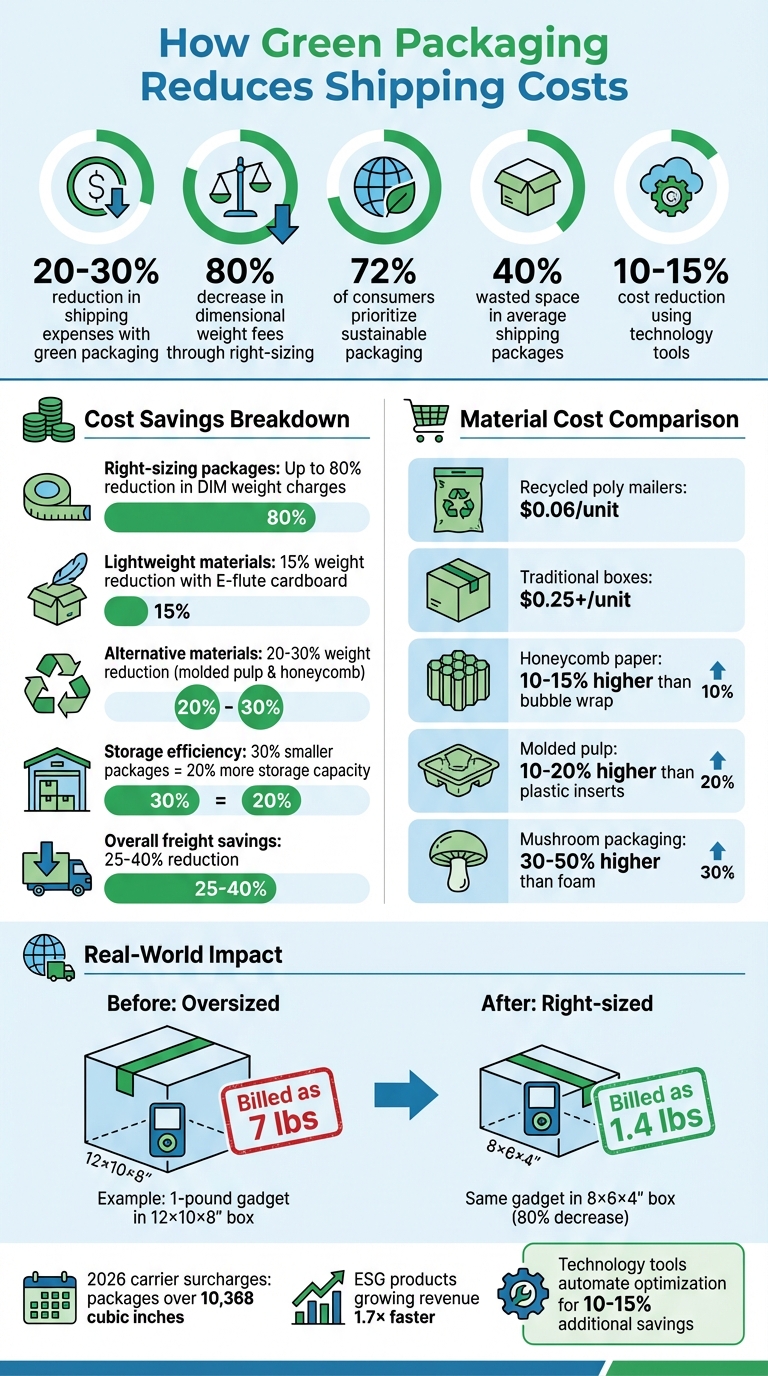
Green Packaging Cost Savings: Key Statistics for Reducing Shipping Expenses
What Green Packaging Is and How It Saves Money
Defining Green Packaging
Green packaging - sometimes referred to as sustainable or smart packaging - focuses on using materials and designs that are kinder to the planet while still protecting products effectively. It often includes recycled content, biodegradable materials, and recyclable options.
Some popular materials in green packaging are recycled corrugated cardboard, molded pulp (made from recycled paper), cornstarch-based packing peanuts, mushroom packaging (grown from mycelium), and honeycomb paperboard. These materials are designed to break down naturally or be easily recycled, helping to reduce the amount of waste sent to landfills. On top of that, the design philosophy moves away from bulky filler materials, instead relying on structural innovations that provide strength with less material.
This environmentally friendly shift doesn’t just help the planet - it can also lead to noticeable savings on shipping costs.
How Green Packaging Cuts Shipping Costs
Switching to eco-friendly materials can have a major impact on shipping expenses.
One of the biggest cost-saving factors is dimensional weight (DIM) charges, which carriers calculate based on a package's size and volume. The formula uses a divisor of 139 for domestic shipments, meaning oversized packages can lead to inflated fees. For example, shipping a 1-pound gadget in a 12×10×8-inch box could be billed as 7 pounds, but using a smaller 8×6×4-inch box reduces the billable weight to 1.4 pounds - an 80% decrease in shipping weight.
"If you are still packing small items in large boxes filled with plastic peanuts, you aren't just hurting the environment - you are likely paying to ship empty air." - Medallion Fulfillment & Logistics
Green packaging also lowers material costs. By right-sizing packages, businesses can reduce the need for void fillers. Using thinner materials like E-flute corrugated cardboard (just 1/16 inch thick) can cut package weight by 15%. Alternatives like molded pulp and honeycomb paperboard further reduce shipping weight by 20% to 30% compared to traditional options. Plus, smaller packages take up less space in warehouses - a 30% reduction in package size can boost storage capacity by 20%, ultimately lowering operational costs per item.
sbb-itb-ed0a9d1
Oversized Packaging Is Costing You Money
Selecting Eco-Friendly Packaging Materials
Finding the right materials for packaging is a smart way to cut down on shipping costs while keeping sustainability in mind.
Lightweight Materials That Lower Costs
Choosing lightweight materials helps reduce shipping expenses without compromising product protection. For example, Kraft paper is an affordable, biodegradable option for void fill. When it comes to soft goods like clothing, recycled poly mailers or compostable mailers are a great choice. These start at just $0.06 per unit, compared to boxes that can cost $0.25 or more. Mailers also adapt to the shape of the product, which helps minimize extra volume and avoid DIM (dimensional weight) charges.
For cushioning, air pillows are a great solution. They offer protection without adding much weight - one cubic foot of air weighs just 1.23 ounces. Another eco-friendly option is cornstarch-based packing peanuts, which provide similar protection and dissolve in water, making them environmentally friendly. If boxes are necessary, 32 ECT corrugated cardboard is a solid choice for items under 20 pounds, offering reliable support with minimal weight.
"Lightweighting packaging is not optional. Lighter packaging means less risk of repetitive stress injuries in the warehouse. It also means trucks can deliver the same volume of products without as heavy a load." - Emily Newton, Editor-in-Chief, Revolutionized
For shipments that need extra protection, consider more durable eco-friendly materials.
Durable Eco-Friendly Options
When shipping fragile or valuable items, durability becomes just as important as weight. Honeycomb paper wrap is a recyclable alternative to plastic bubble wrap, offering excellent protection for items like glassware and ceramics. While it costs 10–15% more than traditional bubble wrap, it ensures the entire package can be recycled curbside. Another option is molded pulp trays, which secure electronics or luxury goods by minimizing movement during transit. These trays are compostable and typically cost 10–20% more than plastic inserts.
For the most delicate shipments, mushroom packaging made from mycelium is a standout choice. This home-compostable material is an effective replacement for polystyrene foam, especially for electronics. However, it comes at a premium, costing 30–50% more than traditional alternatives. For high-value items, a layered approach works best: wrap the product in honeycomb paper, secure it in a molded pulp tray, and fill any remaining gaps with biodegradable packing peanuts or air pillows.
| Material | Best For | Cost vs. Traditional | Key Benefit |
|---|---|---|---|
| Kraft Paper | Void fill, general use | Lower | Biodegradable, low cost |
| Recycled Poly Mailers | Apparel, soft goods | Similar or lower | Reduces DIM weight charges |
| Honeycomb Paper | Fragile protection | 10–15% higher | Recyclable bubble wrap alternative |
| Molded Pulp | Cushioning, inserts | 10–20% higher | Compostable, reduces movement |
| Mushroom Packaging | Electronics, fragile items | 30–50% higher | Home compostable, replaces foam |
Designing Packaging for Lower Shipping Costs
Choosing eco-friendly materials is just one piece of the puzzle. Smart packaging design can take things further by cutting shipping costs, minimizing wasted space, and ensuring smooth handling. Did you know the average shipping package contains about 40% wasted space? That inefficiency leads to higher costs due to dimensional weight charges. By focusing on more compact designs, you can trim freight expenses by 25% to 40%.
Right-Sized Packaging to Eliminate Wasted Space
Shipping carriers don’t just charge by weight - they also factor in package volume. That’s why reducing the size of your packaging is key to lowering dimensional weight charges.
Starting in 2026, carriers will impose extra fees for packages exceeding 10,368 cubic inches and even higher surcharges for those over 17,280 cubic inches. Staying under these thresholds can lead to big savings on every shipment.
Tools like multi-depth cartons with pre-scored fold lines allow for flexible box sizing, cutting down on the need for a variety of box sizes. Custom dielines, tailored to fit your product’s exact dimensions, take this a step further. Instead of stuffing empty spaces with loose fillers, consider die-cut corrugated inserts or molded pulp to secure products in smaller boxes.
"The goal is not 'more padding.' The goal is 'less movement,' in the smallest package that survives the journey." - Nautical Manufacturing & Fulfillment
For sturdy items like books or electronics, Ships in Own Container (SIOC) packaging is worth exploring. This method eliminates the need for an outer shipping box, reducing both material costs and dimensional weight. Amazon’s "Ships in Product Packaging" program, for example, reported that 12% of its global shipments in 2024 used this method.
Once your box sizes are optimized, you can focus on creating compact, stackable designs that improve both warehouse and shipping efficiency.
Compact and Stackable Designs
Getting the dimensions right doesn’t just save on shipping - it can also boost warehouse efficiency. Rectangular, rigid packages work seamlessly with automated conveyor systems, while irregular or bulging boxes often require manual handling, which can tack on extra fees. Clean edges and consistent shapes are your best bet to avoid these costs.
Standardizing box sizes has another advantage: better stacking. When packages have uniform footprints, you can fit more inventory into the same space. Reducing the average package size by 30% can increase storage capacity by 20%. This stacking efficiency benefits both your warehouse and the carrier’s transportation process, ultimately cutting shipping expenses.
It’s also essential to train your fulfillment team to measure the packed shape, not just the empty box dimensions. Overstuffing can cause bulging, which might push a package into a higher surcharge category. Using H-taping patterns can help maintain the box’s shape during transit, avoiding costly remeasurement fees.
If your product is close to a surcharge threshold, focus on slightly reducing two dimensions instead of just the longest side. This strategy lowers the overall volume more effectively, keeping you under those cubic triggers.
Using Technology to Improve Fulfillment
Automating fulfillment processes not only boosts packaging accuracy but also aligns with eco-friendly goals by reducing material waste. Once you've fine-tuned your box designs and switched to sustainable materials, it's time to let technology take over. Manual packaging often leads to oversized boxes, a problem already tackled by right-sizing methods. Today, advanced fulfillment platforms use automation to ensure shipments are cost-efficient and packaging is optimized. This is where tools like box optimization come into play.
Box Optimization Tools
3D bin packing algorithms take the guesswork out of packaging by analyzing product dimensions and automatically choosing the most efficient box size for each order. This eliminates wasted space - often referred to as "shipping air" - which can make up 30–40% of a package's volume when boxes are poorly selected. Navexa’s box optimization feature leverages these algorithms to cut down on dimensional weight charges and reduce packaging waste.
In early 2025, Sarah Chen, Head of Operations at Bloom & Wild, shared how this technology transformed their shipping process:
"Navexa cut our shipping costs by 12% in the first month. The box optimization alone paid for the entire platform."
- Sarah Chen, Head of Operations, Bloom & Wild
The platform also allows users to create custom box profiles and bulk edit product dimensions. This ensures the optimization engine has accurate data, seamlessly combining technology with eco-conscious designs for better efficiency.
Multi-Carrier Rate Comparison
After optimizing packaging, selecting the best carrier becomes the next priority. Even with perfectly packed boxes, choosing the wrong carrier can lead to unnecessary expenses. Multi-carrier rate comparison tools address this by evaluating real-time shipping rates from major carriers like USPS, FedEx, UPS, and DHL, helping businesses find the most cost-effective option for every shipment.
Navexa integrates this feature directly with its box optimization tools, automatically pairing the ideal carrier with the right package dimensions. Marcus Rodriguez, VP of Logistics at Urban Outfitters, highlighted the impact of this feature:
"We ship 10,000+ orders daily and Navexa handles it flawlessly. The multi-carrier rate shopping is a game-changer."
- Marcus Rodriguez, VP of Logistics, Urban Outfitters
The platform itself is free to use, with costs limited to purchasing discounted shipping labels. By combining box optimization with multi-carrier rate shopping, businesses can lower shipping expenses by an average of 10–15%, making a noticeable difference in overall costs.
Conclusion
Adopting green packaging reshapes both shipping costs and environmental impact. By focusing on right-sizing packaging, businesses can eliminate the expense of shipping empty space. Pairing this with lightweight, eco-friendly materials reduces weight-based fees and minimizes material waste. It’s worth noting that the average e-commerce package is 40% larger than the product inside.
Technology plays a key role in automating these sustainable practices. Tools like Navexa use 3D bin packing algorithms and multi-carrier rate shopping to optimize packaging and carrier selection. This combination not only ensures smaller, more efficient packaging but also delivers measurable benefits - companies often see a 10–15% reduction in shipping costs while cutting their carbon footprint.
The financial benefits are hard to ignore. Right-sizing alone can lower shipping costs by 20–30% and reduce material waste by up to 40%. Additionally, ESG-branded products are growing revenue 1.7× faster over a five-year period. With 72% of consumers actively seeking sustainable packaging, adopting green shipping practices is more than just an operational tweak - it’s a way to stand out in a competitive market.
To get started, focus on these steps: audit your packaging to find where dimensional weight exceeds actual weight, standardize a small set of box sizes to meet carrier thresholds, and use cartonization software to automate box selection. These aren’t major overhauls - they’re incremental changes that can add up to substantial savings. As Kristaps Rjabovs, E-Commerce Expert at Magebit, aptly puts it:
"Shipping is not a fixed cost. It is a managed cost. The question is whether you are the one managing it".
FAQs
How do I know if DIM weight is raising my shipping costs?
To determine if DIM weight is affecting your shipping costs, compare your package's actual weight to its dimensional weight. Carriers will charge you based on whichever is higher. If the dimensional weight is greater than the actual weight, your costs could go up. Take a close look at your shipping invoices - this is especially important for large but lightweight packages - to see if charges are being calculated using dimensional weight.
Which eco-friendly packaging works best for fragile items?
For delicate items, opt for packaging that provides excellent cushioning and protection while being environmentally conscious. Consider using padded mailers, corrugated boxes with inserts, or biodegradable packing materials. These choices help safeguard your products during shipping and reduce waste at the same time.
How can Navexa help automate right-sizing and rate shopping?
Navexa leverages advanced algorithms to automatically determine the best box sizes, minimizing dimensional weight charges. It also compares carrier rates in real-time, ensuring businesses always choose the most cost-effective shipping option. By using these tools, e-commerce companies can lower their shipping expenses by 10-15% while making their fulfillment processes more efficient.
Ship your next order through Navexa.
Connect a store, buy a label, and see the numbers yourself.