
Reducing Dimensional Weight with Smarter Packaging
Understanding dimensional weight pricing is crucial for lowering shipping costs in e-commerce. DIM weight charges are based on package size rather than actual weight, meaning oversized packaging leads to inflated fees. For example, a 24" × 18" × 12" box weighing 5 lbs can be billed as 38 lbs. This cost adds up, especially since the average e-commerce package is over 50% empty space.
Here’s how to cut these costs:
- Optimize box sizes: Use right-sized boxes that fit products closely to avoid shipping "air."
- Reduce void fill: Excessive bubble wrap or padding increases box dimensions unnecessarily.
- Switch to mailers: For non-fragile items, padded or poly mailers eliminate DIM charges.
- Leverage cartonization tools: Automate box selection to ensure the smallest suitable packaging is used.
- Track metrics: Monitor DIM weight ratios and void percentage to identify inefficiencies.
Simple changes like resizing boxes or using lightweight materials can save businesses $15,000 to $40,000 annually. For example, switching to a three-box system saved one brand $177,000 per year. DIM weight fees are preventable - focus on smarter packaging to protect your margins.
How Dimensional Weight Works and Why It Costs You Money
What Is Dimensional Weight?
Dimensional weight (often called DIM weight) is a pricing system that considers the space a package takes up rather than just its actual weight. Here's the formula: (Length × Width × Height) ÷ Divisor. Both UPS and FedEx round up each measurement, which can lead to higher billable weights.
Carriers always charge based on the greater value: either the actual weight of the package or the calculated DIM weight.
| Actual Weight | Box Dimensions | DIM Weight (÷139) | Billable Weight |
|---|---|---|---|
| 20 lbs | 10" × 8" × 6" | 4 lbs | 20 lbs (actual weight) |
| 5 lbs | 24" × 18" × 12" | 38 lbs | 38 lbs (DIM weight) |
| 53 lbs | 53" × 12" × 26" | 119 lbs | 119 lbs (DIM weight) |
Note: These examples use a divisor of 139.
Understanding how this calculation works is crucial to seeing why your shipping costs might spike. Using a platform to compare Navexa vs Easyship can help you identify which tools offer the best optimization features for managing these costs.
Why Carriers Charge Based on Dimensional Weight
Shipping trucks and planes have limits on both weight and available space. A lightweight but bulky package can fill up valuable cargo space without maxing out the weight limit, which reduces the carrier's ability to ship other goods. DIM weight pricing ensures carriers are compensated for the space your package takes up.
"Dim weight pricing can reward customers who eliminate extra, oversized packaging. By increasing the shipment density, we can often pack more products on our trucks and planes." - FedEx
The divisor plays a big role here. A lower divisor results in a higher DIM weight and, ultimately, a bigger bill. Here’s how the major U.S. carriers currently calculate DIM weight:
| Carrier | DIM Divisor | When It Applies |
|---|---|---|
| UPS (Daily/Account Rates) | 139 | All package sizes |
| FedEx | 139 | All domestic parcels |
| USPS | 166 | Only for packages over 1 cubic foot (1,728 in³) |
| UPS (Retail/Walk-in Rates) | 166 | UPS Store shipments without a contract |
| DHL eCommerce | 139 | Varies by service level |
This system highlights how packaging decisions can directly affect your shipping costs. Next, let's look at how protective materials can push DIM weight even higher.
How Protective Packaging Adds to Dimensional Weight
Beyond the basic DIM weight calculation, the choice of protective materials can further increase your costs. Materials like bubble wrap, air pillows, and loose fill may be light, but they take up significant space. This often means using a larger box, which increases the DIM weight of your shipment.
Since DIM weight is based on multiplying the package's dimensions, even a small change can add up. For example, adding just one extra inch of padding to each side of a box can significantly boost the total volume. On the flip side, reducing each dimension by even one inch can cut the volume by nearly 25%.
"If your boxes are bigger than they need to be, you're literally paying to ship air." - Margin Lab
The bottom line? Unnecessary void fill or oversized packaging directly translates into higher shipping costs due to increased DIM fees.
sbb-itb-ed0a9d1
Packaging Mistakes That Drive Up Dimensional Weight
Too Much Void Space and Oversized Boxes
One of the biggest culprits behind inflated shipping costs is using boxes that are far too large for the products they carry. When a product only fills half the box, carriers charge for the unused space, driving up costs. According to Margin Lab, this mistake can add an extra $0.50 to $2.00 per shipment, and a staggering 92% of D2C brands are overpaying on packaging because of it.
"Empty space in packages presents a significant cost-saving opportunity." - Brian Byrd, TransImpact
If more than 40% of a box is empty, even a small reduction - like trimming an inch from each dimension - can reduce the overall volume and cut costs by about 25%.
Heavy or Overbuilt Packaging Materials
Another common mistake is using unnecessarily heavy or overbuilt materials. For example, opting for double-wall corrugated boxes or thick foam inserts for items that don’t require that level of protection increases both weight and volume. This approach often adds cost without offering meaningful benefits for non-fragile products.
"The lowest material cost option is often the highest shipping-cost option. In packaging optimization, the winning format is the one that minimizes total landed fulfillment cost, not box spend alone." - Shipped.online
The key is to align the packaging material with the product’s actual needs. A sturdy double-wall box is ideal for fragile glassware, but a padded mailer might be more than sufficient for soft goods.
Using the Same Packaging for Every Product
Relying on a one-size-fits-all packaging approach can quietly drain your budget. When brands default to a single box size for all products, they often end up paying for unnecessary DIM weight. Take the case of a supplement brand shipping 8,000 orders per month: they used a single 12" × 10" × 8" box for every order, resulting in an average DIM weight of 6.9 lbs, even though the actual product weight was just 1.2 lbs. After introducing a 3-box system (8" × 6" × 4", 10" × 8" × 5", and 12" × 10" × 8"), 65% of their orders shifted to smaller boxes. This adjustment saved an average of $1.85 per order, adding up to $177,000 in annual savings.
"A single universal carton sounds efficient, but it usually creates hidden cube waste. When one box must fit a dozen shapes, it becomes larger than needed for most orders. That extra air is not free." - Jordan Blake, Senior Logistics Content Strategist, Shipped.online
Most D2C brands can handle over 90% of their orders with just 3 to 5 standard box sizes. By tailoring packaging to the type of product - fragile items versus soft goods, single-item versus multi-item orders - brands can significantly reduce the "air tax" they pay on every shipment. Fixing these common packaging mistakes lays the groundwork for smarter, tech-driven solutions.
Packaging Materials That Lower Dimensional Weight
Right-Sized Corrugated Boxes
One of the most impactful ways to reduce dimensional (DIM) weight charges is by using boxes that closely fit your products. Single-wall corrugated board provides enough durability for most non-fragile shipments without the added bulk of double-wall options. Pair these with multi-depth boxes, which feature pre-scored lines that allow packers to fold the box to the exact height needed. This eliminates unnecessary headspace, which often increases your DIM weight.
For example, reducing box dimensions from 13" × 11" × 9" to 12" × 10" × 8" cuts the volume by 25%. In February 2026, Smurfit Westrock revealed that a technology brand saved $300,000 in shipping costs and reduced void fill usage by 70% simply by switching to custom multi-depth boxes that better matched their product sizes.
Keep in mind: shipping carriers round up fractional inches to the nearest whole number. That means an 11.1-inch side is billed as 12 inches, and this rounding applies to all three dimensions. Even minor adjustments to box size can significantly lower your shipping costs.
Once your box size is optimized, the next step is choosing the right cushioning materials.
Lightweight Cushioning and Void Fill Options
After selecting the right-sized box, the cushioning inside becomes equally important. The goal is to use just enough protective material to keep the product safe - no more, no less.
"Efficient packaging is about more than simply using a smaller box. It is the art and science of maximizing usable space while protecting the product, optimizing fulfillment processes, and reducing unnecessary costs." - Brian Byrd, TransImpact
Air pillows are an excellent choice for lightweight void fill. They add almost no weight while preventing items from shifting during transit. For products that need more precise positioning, engineered paper pads and molded pulp inserts are great alternatives. Both options offer strong shock absorption without the bulk of foam. Be cautious with bubble wrap; excessive use can increase your box dimensions.
Here’s a quick comparison of common void fill materials:
| Void Fill Type | Cost Per Order | DIM Weight Impact | Best Use Case |
|---|---|---|---|
| Air Pillows | $0.05–$0.15 | None (lightweight) | Filling large voids in lightweight shipments |
| Kraft Paper | $0.08–$0.20 | Minimal | Blocking and bracing; mixed-SKU orders |
| Bubble Wrap | $0.10–$0.30 | Adds volume if excessive | Fragile items |
| Packing Peanuts | $0.15–$0.35 | Adds weight | General cushioning |
| Custom Foam Inserts | $0.50–$2.00 | Low (allows smaller boxes) | High-value or highly fragile items |
A simple test: shake the packed box. If you hear or feel the product moving, your void fill isn’t doing its job - no matter how much material you’ve used.
For products that don’t require heavy-duty protection, consider using mailers instead.
Poly Mailers, Padded Mailers, and Flat Mailers
For non-fragile items like clothing, accessories, and small flat goods, switching to mailers instead of boxes can drastically cut down on volume and DIM fees. Poly mailers and padded mailers take up far less space than even the smallest corrugated box, which can lower your shipping rate or eliminate DIM charges entirely.
For USPS, keeping your package volume under 1,728 cubic inches (1 cubic foot) ensures that DIM pricing doesn’t apply on eligible domestic services - you’ll only be charged based on the actual weight. Lightweight poly mailers make it easy to stay below this threshold for most small items. This simple change reduces both shipping fees and unnecessary packaging bulk while still protecting your products.
Dimensional Weight: Cut Shipping Costs with USPS, DHL, FedEx & UPS | Between The Boxes | FirstMile
Using Technology to Make Better Packaging Decisions
After tackling packaging materials and common mistakes, the next step in cutting down dimensional weight (DIM) fees is leveraging technology.
Setting Cartonization Rules in Your Fulfillment Workflow
Even with the right box sizes and materials available, human decisions on the warehouse floor can be inconsistent. Packers often default to using the nearest, larger box. This tendency, known as "packaging drift," can gradually drive up your DIM fees.
Cartonization offers a solution by automating this process. By integrating cartonization rules into your Warehouse Management System (WMS), the system automatically assigns each order to the smallest suitable container based on SKU dimensions, weight, and fragility - removing the guesswork for packers. This eliminates the risk of oversized box selection.
Start by creating a packaging profile for every SKU that includes dimensions, fragility, and acceptable void fill range. Then, develop a box matrix - usually 3 to 5 standard sizes - that fits 90% or more of your orders while minimizing wasted space. Once implemented, your WMS ensures the right box is consistently chosen.
With automated cartonization in place, the next step involves advanced tools for even smarter packaging decisions.
Box and Material Optimization with Navexa
Manual cartonization rules need constant updating as your product catalog grows. Navexa simplifies this with AI-driven box optimization, automatically matching orders to the smallest suitable box and protective materials to reduce shipping costs.
Navexa’s AI doesn’t stop at box selection - it also identifies the best carrier pairing to further minimize total shipping expenses. As Jordan Blake, Senior Logistics Content Strategist, explains:
"The lowest material cost option is often the highest shipping-cost option. In packaging optimization, the winning format is the one that minimizes total landed fulfillment cost, not box spend alone."
Navexa even provides a savings calculator to estimate how much you could save on shipping costs before committing to any changes.
Using Analytics to Track and Improve Packaging Performance
Automating packaging decisions is just the beginning. Continuous analytics are key to ensuring these optimizations deliver ongoing savings.
One crucial metric to track is your DIM weight ratio: the ratio of billed weight to actual weight. If this number regularly exceeds 1.3x, cartonization software could significantly benefit your operation. Optimized warehouses often lower this ratio from 2.1x to approximately 1.2x, cutting DIM overpayment by 43%.
A weekly scorecard can help you stay on track. Monitor metrics like average carton volume, cube utilization rate, shipping cost per order, and damage rate. For instance, cube utilization below 75% signals a need to adjust box sizes. Pair this data with SKU-level shipping costs to identify the top 20% of products driving your expenses - these should be your first targets for packaging adjustments.
"If you can't see the waste, you can't fix it." - Bart Gadeyne, CEO & Co-Founder, Optioryx
Another key indicator is void percentage. If empty space in a box exceeds 40% of its volume, it’s a clear sign that box size needs to be reevaluated. Tools like Navexa’s real-time reporting make it easier to identify and address these inefficiencies before they spiral into larger monthly losses.
A Step-by-Step Plan to Reduce Dimensional Weight
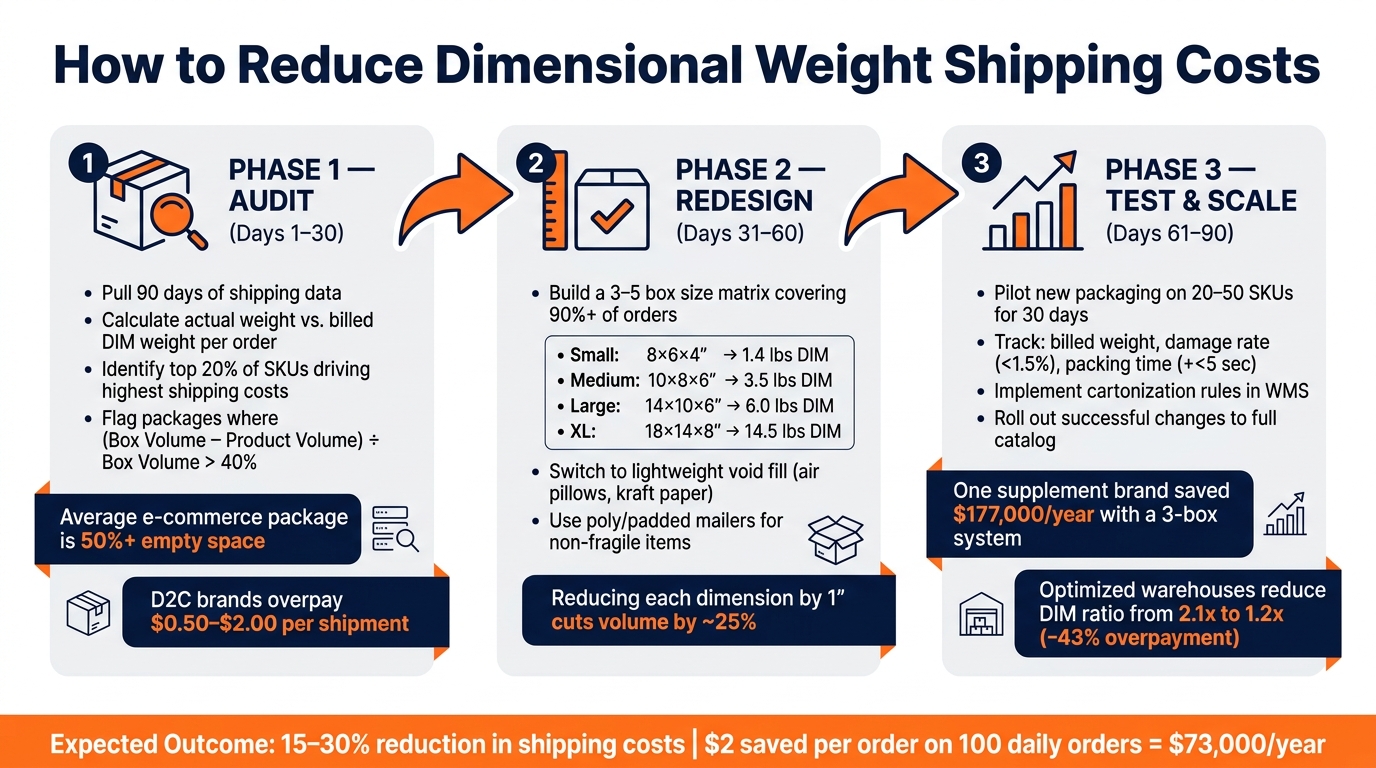
How to Reduce Dimensional Weight Shipping Costs: A Step-by-Step Plan
Here's a practical plan to help you cut down on dimensional weight fees by improving how you handle packaging.
Conducting a Packaging Audit
Start by gathering shipping data from the past 90 days. Calculate the difference between the actual weight and the billed dimensional weight (DIM weight) for each order. It's worth noting that the average e-commerce package contains over 50% empty space, and D2C brands often overpay by $0.50 to $2.00 per shipment due to inefficiencies in DIM weight.
Focus on two key areas during your audit:
- The top 20% of SKUs responsible for the highest shipping costs.
- The 20% of packages with the largest cube-to-weight ratio.
For these groups, record details like box dimensions, product weight, fill materials, damage rates, and carrier lanes. Don’t forget to include the weight of packing materials, as they can contribute to unnecessary DIM charges.
To identify potential problem areas, use this formula:
(Box volume − Product volume) ÷ Box volume
If the result is over 40%, that package is likely a candidate for resizing.
This audit will provide clear insights to guide your packaging redesign efforts.
Redesigning Your Packaging Standards
Once you've pinpointed the waste, the next step is simplifying your box selection. Most D2C brands can cover 90% of their orders with just 3–5 standard box sizes. Here’s an example of an efficient box size matrix:
| Box Size | Dimensions | DIM Weight (139 Divisor) | Best For |
|---|---|---|---|
| Small | 8" × 6" × 4" | 1.4 lbs | Single small items (e.g., supplements) |
| Medium | 10" × 8" × 6" | 3.5 lbs | 1–2 items (e.g., skincare sets) |
| Large | 14" × 10" × 6" | 6.0 lbs | Multi-item orders, larger products |
| XL | 18" × 14" × 8" | 14.5 lbs | Large bundles, home goods |
| (Source: Margin Lab, 2026) |
When redesigning, consider the fragility of each SKU, stacking requirements, and necessary protection. A simple adjustment, like reducing a box dimension from 12.1" to 11.9", can avoid unnecessary increases in billable weight, as carriers round up fractional inches.
"The goal is not to minimize every cubic inch at all costs. The goal is to design packaging that protects the item, fits the SKU mix, works with your fulfillment services workflow, and prices out well..." - Shipped.online
Once your new packaging standards are ready, it's time to test them on a smaller scale.
Testing and Scaling New Packaging Approaches
Instead of making wholesale changes, test your new packaging designs on 20–50 SKUs over 30 days. Monitor key metrics like billed weight, damage rates, and packing time during this trial period. Set clear goals, such as reducing billed weight by 12%, keeping damage rates under 1.5%, and limiting any increase in packing time to no more than 5 seconds.
For example, a supplement brand shipping 8,000 orders monthly had been using one box size for all shipments, despite an average product weight of just 1.2 lbs. By switching to a three-box system, they achieved significant annual shipping savings. The entire rollout took just four weeks.
Once the new approach is validated, update your fulfillment technology to prevent reverting to oversized packaging. A structured 30/60/90-day plan can help manage the process:
- First 30 days: Audit packaging.
- Next 30 days: Test new packing standards.
- Final 30 days: Implement successful changes into warehouse processes and reorder systems.
Conclusion: Reduce Shipping Costs with Smarter Packaging
Smarter packaging isn't just about logistics - it’s a direct way to cut shipping costs. By focusing on packaging as a financial decision, businesses can avoid unnecessary dimensional weight fees and improve their bottom line.
Simple strategies like right-sizing boxes, using lightweight materials, and customizing packaging for specific orders can lead to 15–30% in shipping savings, all while increasing profit margins.
"Dimensional weight charges are one of the most preventable profit leaks in ecommerce shipping." - Jordan Blake, Senior Logistics Content Strategist
Consistency in packaging processes is equally important. Regularly tracking metrics like carton volume, cube utilization, and damage rates can help keep packaging practices efficient and effective. For sustained results, tools like Navexa and ShipStation can be invaluable. These tools automate the process by matching orders to the most suitable box, ensuring long-term cost savings.
Even modest improvements can add up quickly. For example, saving just $2 per order on 100 daily orders translates to $73,000 in annual savings. This kind of result shows the power of treating packaging as a key cost center. By combining optimized packaging techniques with smart technology, e-commerce brands can transform dimensional weight fees from a financial burden into a competitive edge.
FAQs
What box sizes should I stock first?
Begin by selecting box sizes that align closely with the dimensions of your most frequently shipped products. This helps minimize empty space inside the box, reducing both waste and potential dimensional weight charges. Opt for standard or custom box sizes tailored to your typical SKUs, steering clear of packaging that's unnecessarily large. Using box sizes that can handle multiple products or standard dimensions not only cuts costs but also supports more eco-friendly shipping practices.
How do I measure DIM weight the right way?
To determine DIM weight correctly, here's what to do:
- Measure dimensions: Take the length, width, and height of the package in inches, measuring from the outermost points.
- Calculate the volume: Multiply these three measurements together to get the total in cubic inches.
- Use the DIM divisor: Divide the volume by the DIM divisor provided by the carrier (commonly 139 or 166).
- Compare weights: Check both the DIM weight and the actual weight, and use whichever is higher for billing purposes.
Following these steps ensures you're accurately accounting for shipping costs.
How can I cut DIM fees without more damage?
If you're looking to cut down on DIM fees while keeping your products safe, the key lies in smarter packaging. Start by choosing right-sized boxes - ones that fit your product snugly without leaving unnecessary empty space. Too much empty space not only adds to your dimensional weight but also increases the risk of product damage during shipping.
Here’s how to get it right:
- Measure accurately: Take precise measurements of your products to ensure the packaging fits closely.
- Use efficient packing materials: Opt for materials that prevent shifting without adding bulk. Think air pillows, foam inserts, or biodegradable fillers.
- Calculate DIM weight regularly: Use your carrier’s formula and divisor to stay on top of dimensional weight charges.
Finally, don’t treat this as a one-time fix. Continuously review and tweak your packaging process. This way, you can strike the perfect balance between saving on costs and keeping your items well-protected.
Ship your next order through Navexa.
Connect a store, buy a label, and see the numbers yourself.