How to Minimize Customs Delays in Shipping
Customs delays can disrupt your shipping process, hurt customer satisfaction, and add unexpected costs. The good news? Most delays are preventable. Here’s what you need to know:
- Incomplete or incorrect paperwork causes over 90% of delays. Always double-check your documents.
- Key documents include the Commercial Invoice, Packing List, and transport documents like a Bill of Lading or Air Waybill. Additional forms may be needed for specific goods or destinations.
- Accurate HS codes are critical. Misclassification can lead to penalties and inflated costs.
- Country-specific regulations must be followed, including permits, certifications, and packaging standards.
- Real-time shipment tracking and quick responses to customs inquiries prevent small issues from escalating.
- Automation tools can handle documentation, classification, and compliance faster and with fewer errors.
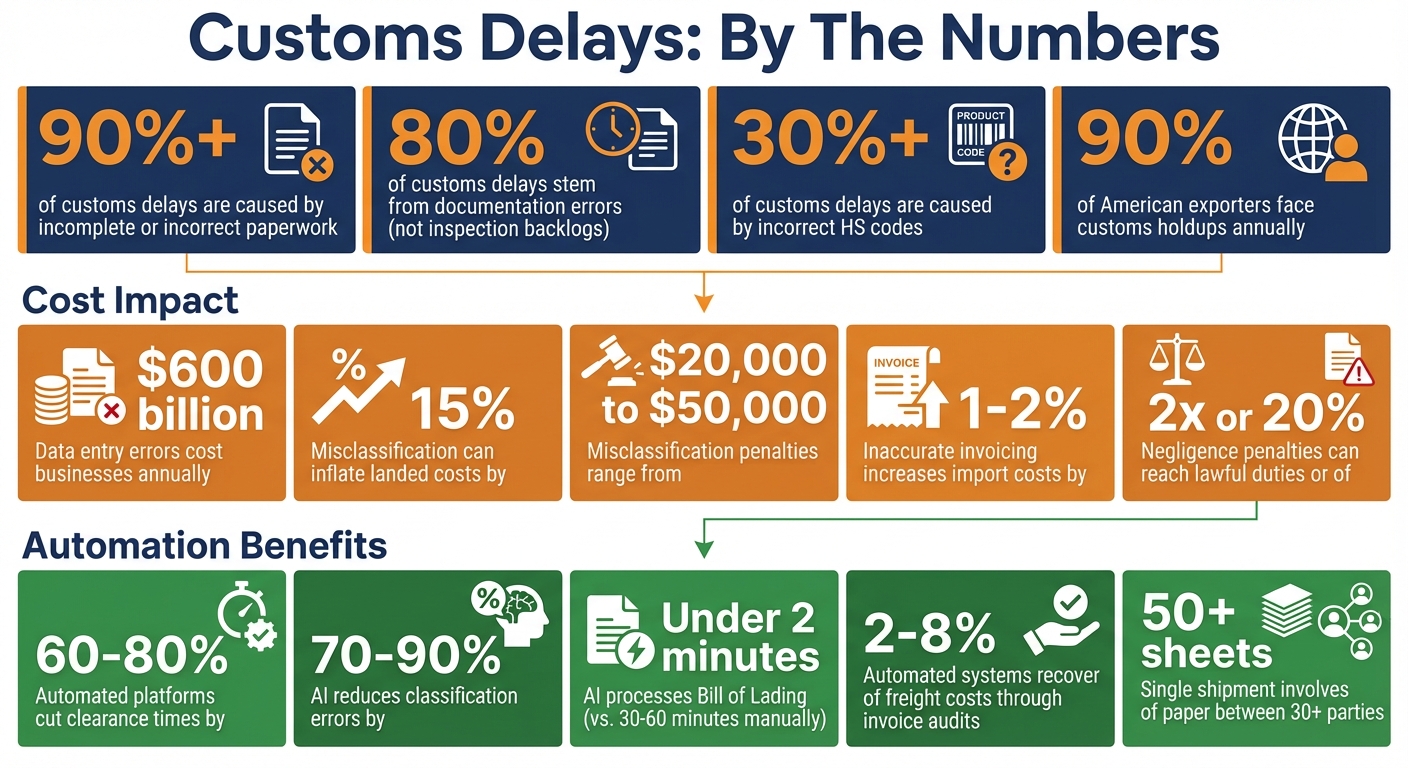
Key Statistics: Customs Delays in International Shipping
How to Avoid Customs Delays: Top Tricks and Tips
sbb-itb-ed0a9d1
Prepare Complete Shipping and Customs Documentation
Did you know that over 90% of customs delays happen because of incomplete or incorrect paperwork? This makes it clear: getting your documents right before shipping is crucial. The paperwork you prepare determines whether your shipment sails through customs or gets stuck in frustrating delays.
For international shipments, there’s a standard set of documents you’ll need. These include the Commercial Invoice (used to calculate duties), a Packing List (which outlines the cargo contents), and a transport document like a Bill of Lading for ocean freight or an Air Waybill for air shipments. Depending on your shipment’s destination or the type of goods, additional paperwork - like a Certificate of Origin for reduced duty rates under trade agreements or permits for regulated items like food or electronics - may also be necessary. Let’s break down how to figure out what documents you need and how to ensure they’re correct.
Identify Required Customs Documents
The documents you need can vary depending on the destination. For example, if you’re shipping to the United States via ocean freight, you’ll need to submit an Importer Security Filing (ISF 10+2) at least 24 hours before your shipment is loaded. If you’re shipping to the European Union, you’ll need an EORI number for customs declarations. Additionally, shipments worth more than €1,000 or weighing over 1,000 lbs typically require an Export Accompanying Document (EAD).
Working with a licensed customs broker can help you navigate these destination-specific regulations and avoid costly mistakes. It’s also worth checking if the destination country has a free trade agreement with the U.S., like USMCA or the U.S.-Chile FTA. These agreements can significantly lower or eliminate duties - provided you have the right preference documents.
Once you’ve identified the required documents, the next step is to ensure every detail is correct.
Verify Accuracy and Completeness
As Modaltrans emphasizes: "Accuracy and consistency across all documents are non-negotiable". Before shipping, conduct a thorough audit of your paperwork. Make sure that piece counts, weights, and values match across all documents to avoid discrepancies that could lead to customs holds.
To maintain consistency, create a master dataset for each product line. This should include details like HS codes, country of origin, and unit values. Avoid vague descriptions like “parts” or “samples.” Instead, be specific. For example, instead of “clothing,” write “Men’s T-shirt, 100% cotton.” This level of detail helps customs officers process your shipment without unnecessary delays.
Here’s a quick guide to key fields you should double-check before submitting your documents:
| Document Type | Key Fields to Verify Before Submission |
|---|---|
| Commercial Invoice | HS codes, unit/total value, currency, Incoterms, country of origin |
| Packing List | Carton/pallet counts, net/gross weight (lbs), dimensions (inches), item quantities per package |
| Bill of Lading / Air Waybill | Consignee details, piece counts, and weights (must match the packing list) |
| Certificate of Origin | Origin statement, HS mapping, and alignment with invoice descriptions |
Confirm Compliance with Import and Export Regulations
Getting the paperwork right is just the beginning - complying with the laws of the destination country is equally important. Each country has its own rules about what can be imported, how items must be labeled, and what permits are needed. Overlooking even one requirement can halt your shipment at the border.
As Harris Sliwoski points out, customs compliance is key to keeping your supply chain running smoothly. It’s not just about avoiding delays but also about steering clear of hefty penalties. For instance, negligence penalties can be as high as twice the lawful duties owed or 20% of the dutiable value. Misclassification errors can cost millions in penalties. By focusing on both accurate documentation and regulatory compliance, you can avoid expensive disruptions.
Research Country-Specific Regulations
Fulfilling the paperwork requirements is not enough; you must also meet the specific regulatory demands of each destination country. Start by identifying required documentation beyond the basics like a commercial invoice and packing list. Some items, such as food, electronics, or chemicals, may need specialized permits or clearances.
Be aware of regional product standards. For example, electronics and machinery may need a CE mark for the EU or a CCC mark for China. Shipping without these certifications can lead to customs rejections.
Check whether your products are subject to special duties or restrictions. Certain goods may face antidumping or countervailing duties, quotas, or enforcement measures like the Uyghur Forced Labor Prevention Act (UFLPA), which flags goods linked to forced labor. Additionally, ensure all products and containers are marked with the country of origin. Failure to do so could result in a 10% marking duty or even seizure.
Don’t overlook packaging requirements. For example, wood packaging must meet ISPM-15 standards, which include heat-treatment stamps. Missing this detail can cause significant delays.
Use Correct Tariff Classification
Once you’ve addressed country-specific regulations, focus on classifying your products correctly to avoid errors in duty calculations. The Harmonized System (HS) code is the global standard for classifying traded goods. Used by more than 200 countries, it covers 98% of global trade. Accurate classification is crucial because it determines your duties, taxes, and eligibility for trade agreements like USMCA.
Incorrect HS codes are responsible for over 30% of customs delays. Misclassification can inflate your landed costs by as much as 15% due to unnecessary duties and penalties. In the U.S., the Harmonized Tariff Schedule (HTS) uses a 10-digit code, updated at least twice a year. Using outdated codes can lead to rejected entries or incorrect duty calculations.
To classify properly, follow the six General Rules of Interpretation (GRI) in order. Base your classification on the material, function, and form of the product - not on marketing terms or brand names. For complex or high-value items, consider requesting a binding ruling from customs authorities like U.S. Customs and Border Protection (CBP). This provides legal certainty and shields you during audits.
"The binding ruling process is one of the most underutilized tools in international trade. A single ruling request can save an importer hundreds of thousands of dollars in duties and eliminate years of classification uncertainty." – Former CBP National Import Specialist
Regularly verify HS codes for your key products to ensure compliance. Keep detailed records explaining your classification decisions. This shows "reasonable care" and protects you during audits. Under 19 U.S.C. § 1484, you - as the importer of record - are legally responsible for accurate classification, even if you rely on a broker.
Submit Accurate Declarations and Commercial Invoices
Accurate documentation is essential, but precise invoicing takes it a step further by reducing the risk of delays. Once you’ve confirmed compliance with regulations and tariff codes, your next priority should be ensuring the accuracy of your commercial invoices and customs declarations. Mistakes in these documents can not only delay shipments but also increase import costs by 1–2%. The commercial invoice is the cornerstone of customs clearance, determining duties, taxes, and whether your shipment moves forward smoothly or gets held for inspection. Following these steps can help you streamline the customs process.
Write Clear Item Descriptions
Vague item descriptions can lead to customs holds. Using generic terms like "parts" or "samples" makes it difficult for customs officers to verify the contents of your shipment, often resulting in manual inspections. Your descriptions should be so clear that anyone reading the invoice can identify the items without opening the package.
A helpful approach is the Material-Purpose-Use formula: explain what the item is, what it’s made of, and how it’s used. For instance, instead of "clothing", write "Men’s T-shirt, 100% cotton, knit", or replace "parts" with "Replacement wheel hub, aluminum cast". Avoid relying on internal SKU names or part numbers - customs officials don’t have access to your product catalog.
"Describe the item so clearly that even a layperson can identify it. Material, purpose, use – all relevant. Internal names are useless in customs checks." – Anna Kraus, Expert in eCommerce and Logistics, Everstox
Additionally, include critical details like the seller’s and buyer’s legal names, addresses, and tax IDs (e.g., EORI for EU shipments), HS codes (at least six digits, or the 10-digit HTSUS for U.S. imports), the country of origin for each item, Incoterms (e.g., DDP or FOB), and a unique invoice number with the shipment date. These elements are essential for invoice accuracy and ensure that your customs declaration is complete. Remember, all documents - commercial invoice, packing list, and bill of lading - must match perfectly.
Once you’ve nailed down the product details, double-check that the values and quantities are accurate and reflect the true transaction.
Declare Correct Values and Quantities
Under-declaring values to reduce duties is not only against regulations but also a risky move. Customs authorities rely on declared values and quantities to calculate duties and VAT, and inaccuracies can lead to inspections and steep penalties. In the U.S., penalties for negligence can reach up to twice the lawful duties or 20% of the dutiable value. Fraudulent declarations can result in penalties equal to the full domestic value of the goods.
Always report the true transaction value, which is the actual price paid or payable. Don’t forget to include dutiable additions like assists, tooling, royalties, or commissions - these are often overlooked but must be factored in. To avoid errors, establish a review process where a second person checks invoices and packing lists for discrepancies before shipping. Ensure that your commercial invoice, packing list, purchase order, and bill of lading reflect consistent quantities and values.
"Unintentional undervaluation is still a violation. Typical misses: unreported assists/tooling/royalties, mischaracterized buying commissions, and transfer-pricing true-ups not reconciled post-import." – Harris Sliwoski
As the importer of record, you’re legally responsible for the accuracy of your declarations under the "reasonable care" standard (19 U.S.C. § 1484), even if you rely on a customs broker. Keep contracts, lab reports, and valuation memos on file for at least five years to respond quickly to customs inquiries or audits. For U.S. importers, the Automated Commercial Environment (ACE) portal is a valuable tool for tracking entries and catching errors before they escalate. These final checks help solidify a strategy to avoid customs-related delays.
Monitor Shipments and Respond to Customs Inquiries Quickly
Once you've ensured your paperwork is accurate and compliant with regulations, the next step is to actively monitor your shipments. While proper documentation gets your goods to the border, keeping an eye on their progress ensures they clear customs without unnecessary delays. With over 90% of American exporters facing customs holdups annually due to missing or incorrect paperwork, catching and addressing issues early can make all the difference.
By combining accurate documentation with real-time tracking and efficient communication, you can minimize disruptions.
Use Real-Time Tracking Tools
Real-time tracking isn’t just about knowing where your shipment is - it helps identify why a customs hold might occur. Whether it’s missing documents, restricted items, or unpaid duties, tracking tools with automated alerts can flag these problems before they escalate. By checking your shipment’s status daily, you can quickly spot "held at customs" notifications and act to avoid costly storage fees.
If your shipment is flagged, contact your carrier right away using the tracking number for guidance on resolving the issue. Many carriers now offer online portals where you can pay duties or taxes immediately, speeding up the release process. To stay prepared, maintain a digital archive of key shipping documents - like commercial invoices, packing lists, and HS codes - so you can provide them on demand when customs inquiries arise.
While technology helps identify issues, timely human intervention is what resolves them.
Stay Available for Customs Communication
Customs officials may stop shipments to verify contents, collect duties, or enforce safety regulations. Ignoring their inquiries can lead to mounting storage fees, fines, or even the return of your shipment. Designate someone who has full access to shipment details and the authority to respond immediately. This person should be equipped with all necessary documents and empowered to approve costs for inspections or bonded storage without waiting for internal sign-offs.
To streamline communication, prepare templates for common requests, such as material descriptions, proof of value, or missing licenses. Set up real-time alerts for customs status changes so you can act quickly. As Jeezan Cargo highlights, prompt responses help resolve issues faster. If you’re working with a customs broker, ensure they have a valid power of attorney to handle declarations and inquiries on your behalf, reducing delays caused by waiting for approvals.
Use Automated Platforms for International Shipping
Manual customs processing can be a logistical nightmare, bogging down operations and inflating costs. Imagine this: a single international shipment might involve over 50 sheets of paper exchanged between 30 or more different parties. Each handoff creates a new opportunity for data entry errors, which collectively cost businesses a staggering $600 billion annually. The solution? Automated platforms that handle routine documentation, freeing your team to focus on more complex challenges. These tools modernize and simplify the entire shipping process.
Fulfillment platforms take the drudgery out of customs work. Tasks that used to take 30–45 minutes - like manually entering customs declaration data - can now be completed by AI in under 5 minutes. And here's the kicker: 80% of customs delays are due to incorrect or missing documentation, not inspection backlogs.
Automate Documentation Management
AI-powered platforms excel at managing documentation with speed and accuracy. Using Intelligent Document Recognition, these systems can extract data from invoices, packing lists, and bills of lading far more accurately than manual methods. They also cross-check documents to catch issues like quantity mismatches or missing certificates before filing with customs. For example, AI can reduce Bill of Lading processing time from 30–60 minutes to just under 2 minutes.
Natural Language Processing (NLP) adds another layer of efficiency by mapping product descriptions to the correct Harmonized System (HS) codes. By cross-referencing regulatory databases, these platforms achieve up to 95% accuracy. Tools like Navexa even allow you to maintain a centralized database with pre-validated HS codes and country-of-origin data for each item, ensuring consistent classifications across all shipments.
Pre-clearance risk scoring is another game-changer. By evaluating shipment data for completeness, valuation accuracy, and restricted-party screening days before the cargo reaches port, businesses can address issues - like a missing certificate of origin or inconsistent declared value - while the shipment is still at its origin. This proactive approach prevents costly delays at the border.
"Catching a quantity mismatch before filing takes seconds; resolving it after an examination hold takes days." – Customiser
Integrate Shipping and Compliance Systems
When shipping, compliance, and tracking systems operate separately, manual data transfers become inevitable - and prone to errors. By integrating these systems, you ensure seamless data flow, reducing the need for repetitive data entry. For instance, Navexa integrates directly with the U.S. Customs and Border Protection's Automated Commercial Environment (ACE), allowing entry fields to be pre-populated and validated automatically.
The benefits of automation are clear. Automated customs platforms can cut clearance processing times by 60–80%. They also reduce classification errors by 70–90% compared to manual methods. Urban Outfitters, for example, used Navexa to handle over 10,000 daily orders in 2026. Marcus Rodriguez, their VP of Logistics, credited the platform's multi-carrier and automated shipping tools for flawlessly managing high-volume fulfillment.
Real-time tracking integration adds another layer of efficiency. Smart Alerts notify teams of customs holds or missing documents as they happen. Meanwhile, digital storage of trade documents enables businesses to respond to customs inquiries in minutes instead of hours. Automated platforms even simplify returns by linking items to their original export proof, ensuring "returned goods" declarations avoid double taxation.
Conclusion
Customs delays can often be avoided by ensuring your documentation is accurate and consistent. As noted, about 80% of customs delays stem from documentation errors. Keeping your commercial invoice, packing list, and bill of lading aligned is critical - any discrepancies can trigger inspections that further slow down the clearance process.
Taking proactive measures is far more effective than scrambling to fix issues later. As BorderBuddy aptly states:
The easiest customs delays to resolve are the ones that never happen.
Steps like verifying HS codes before shipping, choosing DDP Incoterms to handle import charges, and securing Power of Attorney documentation in advance can help you sidestep potential problems. These actions not only ensure smoother border crossings but also protect your finances - penalties for product misclassification can range from $20,000 to $50,000. By addressing these issues early, you can keep deliveries on schedule and avoid costly setbacks.
Technology also plays a pivotal role in simplifying customs processes. Tools like Navexa automate documentation management and integrate with systems such as the U.S. CBP's Automated Commercial Environment (ACE), cutting clearance times by 60–80%. With AI handling routine data extraction, your team can focus on resolving more complex issues instead of chasing down missing paperwork.
Automation doesn’t just save time - it significantly reduces errors. Automated platforms can lower classification mistakes by 70–90% and recover 2–8% of freight costs through systematic invoice audits. For high-volume shippers, these improvements mean fewer penalties, reduced expenses, and happier customers. In sectors like automotive or electronics, where just-in-time delivery is critical, minimizing customs delays isn’t just about logistics - it’s a clear competitive advantage.
FAQs
What should I do first if my shipment is “held at customs”?
If your shipment is marked as “held at customs,” the first step is to figure out why. Reach out to your shipping carrier or the customs authority for clarification. Double-check that all necessary paperwork is filled out accurately and submitted. Also, confirm whether there are any unpaid duties or fees. Addressing these matters quickly can help move the process along and get your shipment released sooner.
When should I request a binding ruling for HS code classification?
If you're unsure about the correct tariff classification for your product, it's a good idea to request a binding ruling for its HS code. This is particularly important in situations involving products with significant duty differences, items that are new or uncommon, or classifications that could impact regulatory compliance. A binding ruling offers legal clarity, helping you determine accurate duties and meet compliance requirements before your goods are shipped.
What’s the easiest way to keep invoices, packing lists, and airway bills consistent?
Automating document processing is a simple yet effective solution. By using automated systems, data from invoices, packing lists, and airway bills can be synchronized seamlessly. This approach reduces manual errors and ensures that all documents align with the shipment details. Such consistency helps eliminate discrepancies, cutting down the chances of customs delays. With automated workflows in place, accuracy and uniformity are maintained, making the entire shipping process more efficient and hassle-free.
Ship your next order through Navexa.
Connect a store, buy a label, and see the numbers yourself.