
How Real-Time Tracking Improves Last-Mile Delivery
Real-time tracking is no longer optional - it’s a must-have for last-mile delivery. Why? Because it addresses three key challenges: inaccurate delivery times, poor visibility, and rising costs. Customers now demand live updates, and businesses that fail to deliver risk losing them.
Here’s what real-time tracking brings to the table:
- Dynamic ETAs: Updates adapt to traffic, weather, and delays, reducing failed deliveries by up to 50%.
- Improved Visibility: Both customers and businesses know exactly where packages are, cutting "Where Is My Order?" calls by 25–45%.
- Cost Savings: Optimized routes lower fuel costs by 8–15%, while reducing overtime by 10–20%.
A single failed delivery costs businesses an average of $17.20. Multiply that by thousands of orders, and the impact adds up fast. Tools like Navexa integrate tracking, notifications, and analytics to minimize these losses while boosting efficiency and customer satisfaction.
Bottom line: Real-time tracking saves money, keeps customers happy, and turns delivery into a competitive advantage.
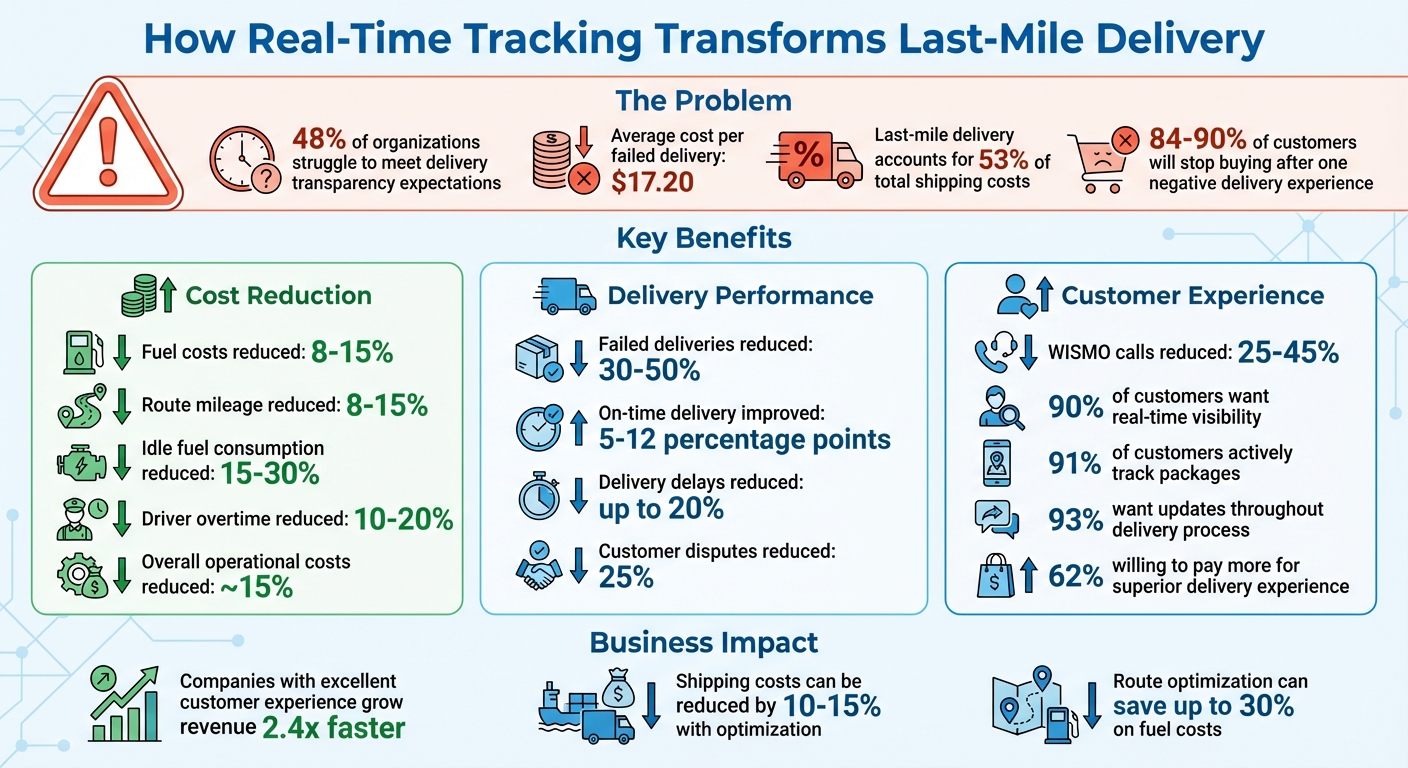
Real-Time Tracking Impact on Last-Mile Delivery: Cost Savings and Performance Metrics
Better Tracking: Real-Time Tracking in the Last Mile Delivery
sbb-itb-ed0a9d1
Common Last-Mile Delivery Problems
Last-mile delivery, the final step in the shipping process, often faces inefficiencies that frustrate customers and drain company resources. A major issue is the reliance on fragmented systems - where dispatch tools, customer messaging platforms, and tracking systems fail to communicate effectively. This disconnect creates operational blind spots, leaving businesses and customers uncertain about package locations and delivery times. The result? Inaccurate ETAs, poor visibility, and inefficient routing.
The financial toll is hard to ignore. 48% of organizations struggle to meet consumer expectations for delivery transparency. When customers can't track their packages or receive reliable updates, trust erodes quickly, making it harder for businesses to retain their competitive edge.
Inaccurate Delivery Time Estimates
Static ETAs are a persistent headache in last-mile delivery. Traditional tracking systems often send a generic "out for delivery" notification early in the day, leaving customers guessing when their package will actually arrive. These systems fail to account for real-time factors like traffic, weather, or unexpected delays. With multi-stop routes - sometimes exceeding 100 stops per driver - even minor delays can ripple through the schedule, throwing off ETAs for the entire route.
This uncertainty fuels what experts call "pre-parcel anxiety". Customers can't plan their day when they're left wondering if their package will arrive in 20 minutes or four hours. Missed deliveries due to inaccurate ETAs are costly, with businesses losing an average of $17.20 per failed delivery. For companies handling 10,000 orders daily, a 5% increase in failed deliveries can lead to annual losses of approximately $4.5 million. Real-time tracking offers a solution by providing dynamic updates that adapt to changing conditions throughout the delivery process.
Poor Visibility for Businesses and Customers
The absence of real-time visibility creates what logistics experts refer to as a "black box" problem. Dispatchers can't see where drivers are, and customers are left in the dark about their package's location. This lack of information makes it impossible to reroute drivers around traffic or other disruptions.
"That information gap - the lack of real-time visibility into driver location and delivery progress - is one of the most significant challenges in last-mile delivery today." - Navixy
For customer service teams, this visibility gap leads to a surge in "Where Is My Order?" (WISMO) inquiries, consuming valuable time and resources. Real-time tracking can reduce these calls by 25–45%, but many businesses still can't provide basic updates. With 93% of customers wanting updates throughout the delivery process, failing to meet this demand damages trust. The lack of digital proof of delivery - such as photos, timestamps, or signatures - also leaves companies vulnerable to disputes over lost or damaged packages, further straining resources. Real-time tracking addresses these challenges by offering continuous updates and automated proof of delivery.
Inefficient Routes and Rising Costs
Without real-time data on driver locations or traffic conditions, businesses often rely on static route optimization. This approach becomes irrelevant the moment a driver deviates from the planned route. Unexpected pickups, traffic delays, or road closures can quickly render static plans useless, leaving managers unable to proactively address bottlenecks or analyze driver behavior, stop durations, and fuel efficiency.
The financial impact is substantial. Last-mile delivery already accounts for 53% of total shipping costs, and inefficient routing only adds to the expense. Businesses that implement route optimization can save up to 30% on fuel costs. In contrast, outdated systems lead to wasted resources through unnecessary mileage, idle time, and failed deliveries. Real-time tracking enables dynamic route adjustments, helping businesses cut costs and improve operational efficiency.
How Real-Time Tracking Solves These Problems
Real-time tracking directly addresses the delivery challenges discussed earlier by offering precise, actionable solutions. With location data from vehicles and driver apps sent to cloud platforms, businesses can calculate dynamic ETAs that adjust in real time based on traffic, weather, and remaining stops. This shift from static updates to continuous visibility bridges the transparency gap, providing businesses and customers with accurate, constantly updated arrival predictions.
Instead of vague "out for delivery" updates, customers receive automated notifications at key moments - like when the driver begins their route, is one stop away, or encounters unexpected delays. Businesses can also share secure tracking links showing live courier locations without requiring logins. For dispatchers, instant alerts flag exceptions such as geofence breaches, unscheduled stops, or potential service-level agreement (SLA) violations, allowing them to intervene before minor issues escalate.
"Real-time visibility improves last-mile quality in two ways. First, it allows retailers to respond to changes and disruptions quickly without affecting too many customers... Second, it makes customers a part of the process." - Deborah Laloum, Market Research Analyst, Bringg
Live ETAs and Delay Notifications
Dynamic ETA calculations take the guesswork out of delivery timing, continuously updating arrival times based on real-world conditions. For example, if traffic causes a delay, the system automatically recalculates the ETA and notifies customers, helping them plan their day instead of waiting in uncertainty.
One regional furniture carrier, handling 350 deliveries monthly, implemented real-time alerts and shareable tracking links. By identifying issues like incorrect addresses or "no-one-home" scenarios while drivers were en route, they reduced first-attempt delivery failures from 15% to 9% - a 40% improvement. This cut redelivery costs by $3,600 per month (24 fewer redeliveries at $150 each) and lowered overtime expenses by 15%, saving the company roughly $5,000 monthly.
Internal alert systems also keep dispatchers ahead of potential problems. If an ETA crosses a set threshold, the system triggers notifications, avoiding unnecessary alerts while enabling quick rerouting. Two-way communication tools let drivers contact customers through anonymized calls or chats to request gate codes or clarify delivery instructions, further reducing failed attempts. These real-time adjustments streamline operations and build customer trust.
Better Delivery Accuracy
GPS-powered route optimization ensures drivers can adapt to unexpected obstacles like road closures or heavy traffic. The system recalculates the best route and sends updated directions directly to drivers' mobile devices. Geofencing adds another layer of accuracy by creating virtual boundaries around delivery zones. Alerts are triggered when drivers enter or exit these zones, flagging issues like incorrect addresses or absent recipients.
Digital proof of delivery - through photo confirmations, barcode scans, or digital signatures - closes the loop on delivery accuracy. It not only confirms successful drop-offs but also helps dispatchers monitor and verify operations. Once a delivery is completed, the system updates the tracking status and notifies the customer, reducing disputes over "lost" packages and cutting follow-up calls.
A national grocery delivery service processing 600 orders daily used live map rerouting and self-serve ETAs to cut total miles driven by 8%, saving $1,300–$1,500 in monthly fuel costs. This also boosted on-time delivery rates by 6–9 percentage points and reduced first-attempt failures by 30–50%. The system's ability to detect stalled vehicles or late ETAs allowed dispatchers to intervene before delays turned into missed delivery windows.
Better Customer Communication
Proactive updates replace reactive customer support. Real-time tracking systems send notifications at critical stages, reducing "Where Is My Order" (WISMO) inquiries by 25–45%. The grocery operator mentioned earlier saw a 30% drop in WISMO calls, saving approximately $1,404 monthly (at $3 per call).
Customers value this transparency - 90% want real-time visibility into their orders, and 91% actively track their packages. Advanced platforms even allow customers to reschedule deliveries or adjust time windows through self-service portals, making them active participants in the process.
When disruptions like bad weather or traffic delays occur, the system immediately informs affected customers and provides updated ETAs. This level of communication builds trust, as 88% of consumers say the experience a company provides is as important as its products. On the flip side, 84–90% of customers will stop buying from a brand after a single negative delivery experience. By prioritizing transparency and communication, businesses can create a seamless last-mile delivery experience that strengthens customer loyalty.
Business Benefits of Real-Time Tracking
Real-time tracking isn’t just about knowing where things are - it’s a game-changer for cutting waste and saving money. In fact, it can reduce operational costs by around 15%. Beyond the savings, it also brings sharper insights into operations and helps avoid customer disputes.
Lower Costs Through Better Routes
With dynamic rerouting, businesses can slash fuel costs and make better use of vehicle capacity. Dispatchers can use live traffic data to guide drivers around congestion or accidents before delays pile up. This approach cuts route miles by 8–15% and idle fuel burn by 15–30%.
Real-time exception management is another money-saver. Imagine a driver reaching a delivery point only to find no one home. Instead of heading back to the warehouse, dispatchers can immediately reschedule the delivery for later that day while the truck is still nearby, avoiding the extra costs of a return trip. Automated dispatching and continuous monitoring also help by reducing driver overtime by 10–20%.
Data-Driven Performance Insights
The benefits don’t stop with routing. Historical data from real-time tracking opens the door to smarter decisions about driver performance and vehicle maintenance. For example, route playback can reveal bottlenecks, inefficient routes, or areas with high dwell times, allowing managers to tweak capacity planning.
Tracking driver behavior, such as harsh braking or excessive idling, enables targeted coaching to improve safety and fuel efficiency. On top of that, monitoring engine hours and odometer readings helps schedule maintenance proactively, cutting down on unexpected breakdowns and roadside repairs.
A utility company with 85 technicians used these tools to reduce drive time by 12%, freeing up 200 technician hours per month - a boost in capacity worth $11,000. They also cut SLA breaches by 30%, avoiding penalties of $3,000–$6,000 each month. This kind of data turns GPS tracking into actionable strategies that increase both productivity and profitability.
Proof of Delivery and Fewer Disputes
Digital proof of delivery (ePoD) - complete with signatures, photos, and GPS time stamps - provides a clear audit trail. This instantly resolves "package not received" claims, cutting customer disputes by 25%. It also eliminates the need for lengthy investigations or refunds for falsely reported missing items. Geofencing adds another layer of verification, confirming that drivers were physically at the delivery location.
Automated status updates further ease the burden on customer support teams, reducing "Where Is My Order" (WISMO) inquiries by 25–45%. This frees up support staff to focus on more complex issues. Together, these efficiencies turn last-mile delivery into a competitive edge rather than just a cost center.
Customer Experience and Transparency Benefits
Real-time tracking transforms the final mile into a chance to build trust. When customers can see exactly where their package is and when it will arrive, they feel a greater sense of control. This feeling plays a big role in whether they’ll choose to shop with the company again. Consider this: 88% of consumers say that the experience a company provides is just as important as its products or services. This level of transparency not only strengthens customer relationships but also supports the operational improvements discussed earlier, boosting both efficiency and brand reputation.
Live Tracking and Self-Service Options
Today’s customers expect delivery tracking to be as precise as rideshare apps. Features like live GPS maps show the driver’s current location, while "next stop" alerts let customers know how many stops are left before their delivery arrives. Self-service portals add another layer of convenience, allowing customers to reschedule delivery times or change drop-off locations - whether that’s to a neighbor’s house or a secure parcel locker - without needing to contact customer support. Deborah Laloum, Market Research Analyst at Bringg, puts it best:
"Real-time visibility improves last-mile quality... it makes customers a part of the process. Customers should be able to see updates to their order and have a say if any change is needed".
Even when delays happen, instant alerts from the system help maintain customer confidence.
Early Delay Notifications
Proactive alerts take transparency a step further. Automated notifications inform customers immediately when delays occur, whether due to traffic, weather, or unexpected route changes. This approach turns potential frustrations into moments of understanding. It’s also a win for businesses: cutting down "Where Is My Order?" (WISMO) inquiries by 30% allows support teams to focus on more complex issues instead of routine tracking questions.
Strengthening Customer Loyalty
All these efforts - real-time tracking, self-service tools, and proactive updates - work together to build stronger customer loyalty. Delivery transparency encourages repeat purchases, and companies that excel in creating great customer experiences see revenue grow up to 2.4 times faster than their competitors. Features like photo confirmation provide proof of delivery, reducing disputes and reinforcing trust. When customers feel informed and valued, they’re not just satisfied - they become loyal advocates. In fact, 62% of customers say they’re even willing to pay more for a superior delivery experience.
Using Real-Time Tracking with Navexa
Navexa offers a powerful solution to streamline last-mile delivery by combining real-time tracking with automated workflows and advanced tools for cost management. With second-by-second visibility, businesses can track vehicles and parcels on live maps, monitor telemetry data like speed and fuel levels, and even replay trip histories to analyze past performance. These features help businesses cut costs while boosting customer satisfaction.
Easy Integration and Real-Time Analytics
Navexa integrates seamlessly with over 50 e-commerce platforms using webhook automation, ensuring smooth communication between devices and business systems. A standout feature is the ability to embed a "courier-on-the-map" widget directly into checkout pages, letting customers track their deliveries in real time without leaving the site. Additionally, secure, shareable tracking links allow customers to check delivery updates with just one click - no login needed.
The platform also provides real-time analytics to pinpoint bottlenecks and identify underperforming carriers across the delivery network. Dispatchers can address traffic issues on the spot by rerouting drivers and minimizing delays. They can also monitor idling vehicles to reduce overtime and fuel consumption. These tools not only improve operations but also help cut costs.
Cost Reduction and Better Operations
Navexa’s optimization tools are designed to deliver measurable savings. By leveraging intelligent rate shopping and box optimization, businesses can cut shipping costs by 10–15%. Real-time rerouting helps reduce delivery delays by up to 20%, while route mileage typically decreases by 8–15%, and idle fuel consumption drops by 15–30%.
Automated Workflows for Faster Operations
The platform’s automation capabilities simplify operations and improve efficiency. For instance, its event engine sends instant notifications for geofence breaches, speeding incidents, or when high-priority deliveries are nearing their destination. Automated workflows also handle exceptions, such as flagging likely missed deliveries or incorrect addresses, allowing drivers to resolve issues on the go. Proof of delivery is automated with timestamps and geofencing, making the confirmation process quicker and more reliable.
These automation features can reduce overtime hours by 10–20% and increase on-time delivery rates by 5–12 percentage points, ensuring smoother and faster delivery operations.
Conclusion
Real-time tracking has become a game-changer for optimizing last-mile delivery. It transforms this often costly and unpredictable part of the supply chain into a streamlined and transparent process. With up-to-the-minute visibility into driver locations and package progress, businesses can tackle delays head-on, refine delivery routes, and significantly cut failed deliveries - sometimes by as much as 30–50%. These improvements translate directly into cost savings and enhanced efficiency.
For customers, live tracking offers peace of mind and fosters loyalty. With 74% of consumers prioritizing transparency and 84–90% willing to abandon a brand after a single poor delivery experience, keeping them informed is critical. Features like shareable tracking links and live ETAs let customers track their orders independently, reducing "Where Is My Order?" inquiries by 25–45%.
Navexa takes this a step further by combining real-time tracking with smart automation and compatibility with over 50 e-commerce systems. Its tools, like multi-carrier rate shopping and box optimization, lower shipping costs by 10–15%, while automated workflows cut overtime by 10–20% and improve on-time deliveries by 5–12 percentage points. Additionally, real-time analytics pinpoint bottlenecks and underperforming carriers, giving businesses actionable insights to fine-tune their operations.
FAQs
What data is needed to generate accurate dynamic ETAs?
Accurate dynamic ETAs depend on a mix of critical data points. These include the real-time location of the delivery vehicle, current traffic conditions, driver behavior, the time spent at delivery stops, and any route disruptions or delays. Together, these elements help calculate delivery time estimates that are both precise and dependable.
How do you reduce WISMO calls without overwhelming customers with alerts?
Proactively managing WISMO (Where Is My Order) inquiries is all about keeping customers in the loop without overloading them. Offering real-time order tracking with updates at key moments - like when an order is processed, shipped, or delayed - helps customers stay informed. Automated notifications for important events, such as delivery issues, can also reduce confusion and uncertainty.
Making tracking information easy to access on both web and mobile platforms empowers customers to check updates themselves. This approach not only cuts down on support calls but also avoids bombarding customers with too many alerts.
How long does it take to integrate Navexa real-time tracking with my e-commerce stack?
Integrating Navexa's real-time tracking into your e-commerce system is simple and fast. Whether you prefer automated import options or manual data entry, the entire process usually takes just a few minutes. This quick setup helps you get up and running with minimal effort while keeping things efficient.
Ship your next order through Navexa.
Connect a store, buy a label, and see the numbers yourself.