Multi-Carrier Label Printing Explained
Multi-carrier label printing simplifies shipping for e-commerce businesses by integrating multiple carriers (like FedEx, UPS, and USPS) into a single platform. This allows businesses to instantly compare rates, automate label creation, and reduce shipping costs by 10–15%. Automating these processes not only saves time but also improves accuracy, minimizes errors, and ensures smoother order fulfillment.
Key benefits include:
- Cost savings: Real-time rate comparisons reduce shipping expenses.
- Time efficiency: Automation speeds up label creation and order processing.
- Scalability: Handles high-volume shipments during peak seasons.
- Improved customer satisfaction: Faster deliveries and accurate tracking.
For businesses shipping at scale, multi-carrier platforms are a practical solution to manage growing demands, avoid bottlenecks, and optimize shipping operations. Tools like Navexa centralize these tasks, offering integrations with e-commerce platforms, batch processing, and real-time analytics to simplify fulfillment workflows.
Setup Multi Carrier Shipping Label app by PluginHive in Shopify
sbb-itb-ed0a9d1
What Is Multi-Carrier Label Printing?
Multi-carrier label printing is a software-based solution that helps e-commerce businesses streamline their shipping processes with fulfillment resources. Instead of hopping between different carrier portals like USPS, UPS, FedEx, or DHL to create labels, businesses can use a single platform to manage everything. This setup not only simplifies operations but also makes shipping faster and more efficient.
Here's how it works: multi-carrier platforms pull real-time rates and transit times from all connected carriers. They let you compare options side by side, choose the best one, and instantly generate shipping labels. These platforms integrate directly with your e-commerce store, automatically importing order details. When an order comes in, the software calculates shipping costs based on factors like weight, size, and destination. It then suggests the most cost-effective or quickest delivery option for that shipment. For businesses handling large volumes, batch processing allows thousands of labels to be created at once, complete with address validation and compliance checks for each carrier. This automation reduces errors and keeps shipping workflows running smoothly.
"Multi-carrier shipping software connects your ecommerce store with multiple shipping carriers in one centralized platform. It replaces manual tasks like rate comparisons, label creation, and carrier selection with smart automation." – ShipperHQ
How Multi-Carrier Label Printing Works
Multi-carrier label printing streamlines the shipping process into three key steps, helping businesses save time and reduce costs. By automating tasks and minimizing errors, this system ensures a smoother workflow from order placement to label generation. Let’s break it down.
Order Data Integration
The process starts with integrating your e-commerce store with a multi-carrier platform via pre-built API connections. When a customer places an order, the platform pulls all the necessary details - such as the recipient’s address, package weight, dimensions, and SKU - into a single dashboard. For instance, Navexa connects with over 50 platforms, including Shopify, WooCommerce, Magento, and marketplaces like Amazon, eBay, and Etsy. This eliminates the need for manual data entry and includes real-time address validation to catch errors like missing apartment numbers or incorrect ZIP codes. For orders not automatically synced, you can upload them in bulk using CSV files. Once the data is in place, the system moves on to compare carrier options.
Carrier Rate Comparison
The platform then sends the order details to various carrier APIs to evaluate rates and transit times. It compares the options and selects the best service based on your predefined rules, such as prioritizing the lowest cost within a specific delivery window. For example, in 2025, Saks OFF 5TH expanded its carrier network from one to 12 within six months, drastically improving delivery times - nearly 50% of orders arrived within three days. This automated rate shopping can save businesses 10–15% on shipping costs. By automating this step, the system eliminates the need for manual rate checks and speeds up decision-making.
Automated Label Generation
Once a carrier is chosen, the platform sends shipment details to the carrier’s API, which calculates the final rate and generates a shipping label. Labels are typically provided in PDF or thermal printer formats. Automation rules can trigger label creation instantly based on factors like order value or destination. For high-volume shippers, batch processing makes it possible to generate and print hundreds of labels at once. Each label includes sender/recipient information, package details, shipping method, and a tracking barcode. Tracking numbers and fulfillment updates are automatically sent back to your e-commerce platform. For international orders, the system also generates customs forms and HS codes, ensuring compliance and accuracy. This final step not only speeds up fulfillment but also reduces the chance of errors in the shipping process.
Benefits of Multi-Carrier Label Printing
Cost Savings Through Rate Comparison
Using real-time rate comparison can lead to immediate savings. Instead of sticking to fixed rates with a single carrier, multi-carrier software evaluates pricing across national, regional, and specialized carriers for every shipment. This approach can cut shipping costs by 10–15% overall. Smaller businesses also gain access to pre-negotiated commercial rates that would otherwise be out of reach. Plus, built-in address validation tools help catch mistakes that could lead to costly correction fees or returned shipments. Distributing shipment volumes across multiple carriers also strengthens negotiating power and provides a safeguard against sudden rate increases.
Time Savings with Automation
Multi-carrier platforms streamline the process by eliminating the need to juggle multiple carrier portals. They automatically pull order data and enable bulk label processing, allowing teams to handle orders up to three times faster compared to manual methods. This automation frees up valuable time, letting teams focus on scaling the business instead of repetitive, time-consuming tasks.
Better Accuracy and Fewer Errors
Manual data entry often leads to mistakes, whether it's entering shipping addresses, package weights, or carrier details. Multi-carrier software minimizes these errors by pulling data directly from order management systems. Integrated address validation tools fix errors automatically, and the software ensures that labels comply with each carrier’s specific formatting needs, including barcodes, sizing, and layout. As ProShip highlights:
"Accurate shipping labels play a crucial role in ensuring a seamless and timely delivery – which is well-documented to have a direct link to overall customer satisfaction".
Scalability for High-Volume Periods
Peak seasons like Black Friday or back-to-school can overwhelm manual fulfillment processes. Multi-carrier platforms handle these surges with ease, enabling batch processing to generate and print hundreds - or even thousands - of labels at once. Using multiple carriers also reduces reliance on a single provider, ensuring smooth operations even when individual carriers face capacity issues or disruptions during high-demand periods.
Better Customer Experience Through Tracking
Modern customers expect fast, clear delivery updates. Multi-carrier platforms simplify this by offering a unified tracking system across all carriers, making it easier to provide consistent notifications. Real-time data from carriers allows for accurate delivery estimates, which helps address customer inquiries and builds trust. For example, the average expected delivery time has dropped from 2.36 days in 2022 to 1.85 days in 2024. Meanwhile, high shipping costs remain a leading cause of cart abandonment, affecting 39% of online shoppers. By offering precise delivery timelines and competitive rates, businesses can boost conversions and improve customer satisfaction after purchase.
These benefits highlight why multi-carrier strategies often outperform single-carrier models. The following table breaks down the key differences:
| Feature | Single-Carrier Model | Multi-Carrier Strategy |
|---|---|---|
| Primary Goal | Operational simplicity | Cost optimization and performance |
| Carrier Contracts | One national carrier; long-term agreement | Multiple carriers tailored by region/shipment |
| Delivery Decisioning | Static rules (one service for all) | Dynamic selection based on real-time logic |
| Risk Exposure | High; limited flexibility during rate hikes | Distributed; greater resilience and leverage |
| Technology | Low; often manual or WMS-based | High; automated, API-driven execution |
Single-Carrier vs. Multi-Carrier Label Printing
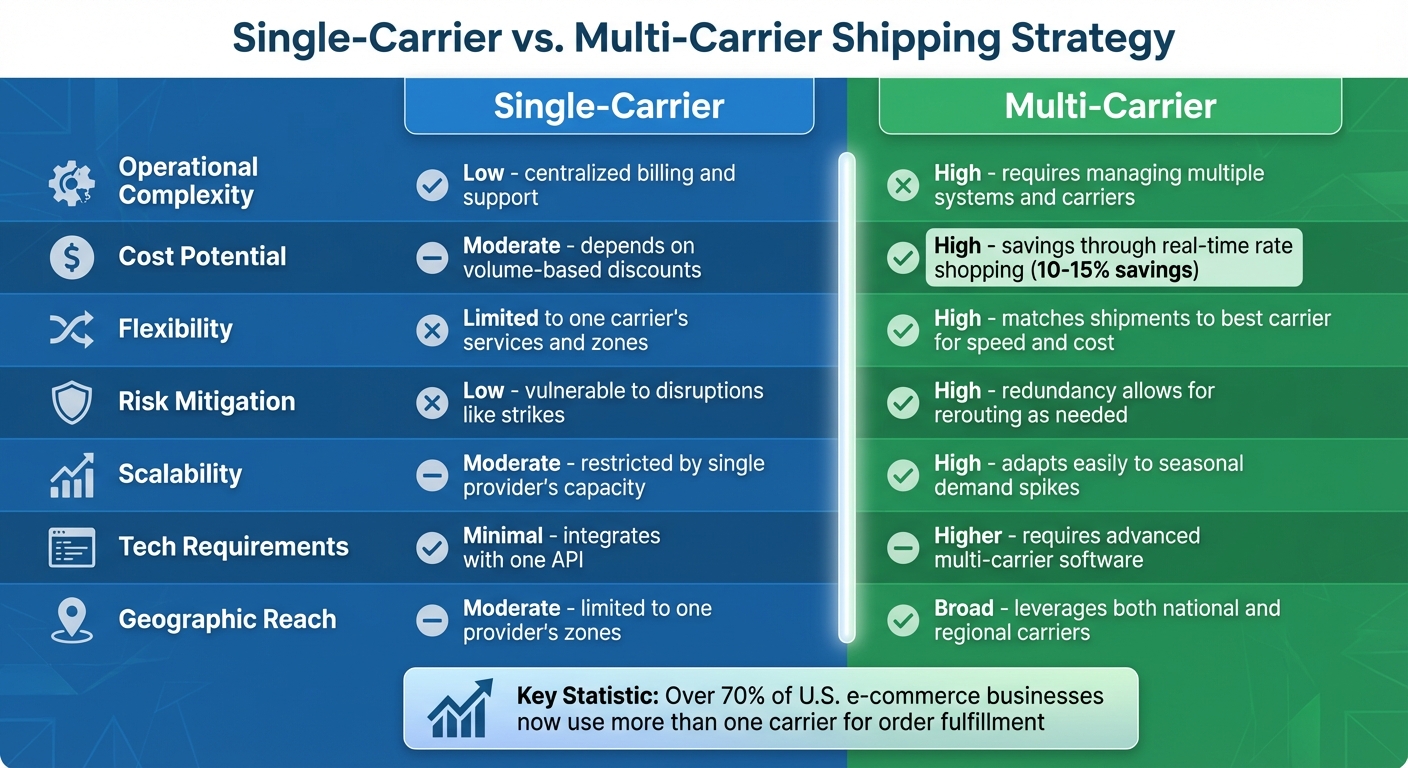
Single-Carrier vs Multi-Carrier Shipping: Key Differences and Benefits
When deciding between single-carrier and multi-carrier setups, it’s essential to weigh your business needs, shipping volume, and growth trajectory. For smaller businesses with low shipment volumes, single-carrier setups can be a practical choice. They simplify operations by centralizing shipments with one provider, often unlocking volume-based discounts. However, as businesses grow and shipping demands increase, multi-carrier setups become an attractive option, offering flexibility and better cost management.
Multi-carrier strategies are particularly beneficial for businesses aiming to scale. In fact, over 70% of e-commerce businesses in the U.S. now rely on more than one carrier for order fulfillment. This approach also provides operational safeguards, reducing risks associated with strikes, weather delays, or carrier capacity issues - challenges that single-carrier setups may struggle to handle.
The choice often comes down to balancing simplicity with performance. Single-carrier systems are easier to manage, requiring minimal infrastructure like a basic warehouse management system or a carrier portal. On the other hand, multi-carrier setups demand more advanced software solutions. These systems automate carrier selection and enable real-time rate comparisons, helping businesses optimize shipping costs.
Here’s a closer look at how these options compare:
Comparison Table Details
| Factor | Single-Carrier Label Printing | Multi-Carrier Label Printing |
|---|---|---|
| Operational Complexity | Low; centralized billing and support | High; requires managing multiple systems and carriers |
| Cost Potential | Moderate; depends on volume-based discounts | High; savings through real-time rate shopping |
| Flexibility | Limited to one carrier’s services and zones | High; matches shipments to the best carrier for speed and cost |
| Risk Mitigation | Low; vulnerable to disruptions like strikes | High; redundancy allows for rerouting as needed |
| Scalability | Moderate; restricted by a single provider’s capacity | High; adapts easily to seasonal demand spikes |
| Tech Requirements | Minimal; integrates with one API | Higher; requires advanced multi-carrier software |
| Geographic Reach | Moderate; limited to one provider’s zones | Broad; leverages both national and regional carriers |
For businesses operating in a concentrated market with predictable shipping volumes, single-carrier solutions keep things simple. But as your business grows, especially into new markets or during peak seasons, a multi-carrier approach can help you maintain efficiency, avoid bottlenecks, and ensure timely deliveries.
Common Challenges and Solutions
Diving into multi-carrier label printing can bring its share of technical headaches. For 42% of retailers considering carrier diversification, technology integration stands out as the biggest obstacle. Each carrier has its own unique APIs, data formats, and operating procedures. This means your development team is constantly playing catch-up, as major carriers typically update their API specifications every six months. The result? A never-ending cycle of maintenance and updates.
Another sticking point is maintaining accurate shipping rates across all carriers. Managing multiple providers often leads to mismatches between the rates quoted to customers and the actual billed amounts. These discrepancies can eat into your shipping margins. To stay on top of this, real-time updates for surcharges, tracking data, and service availability are crucial.
And then there’s the fear of losing volume discounts. Nearly 39% of businesses worry about missing out on deep discounts when splitting shipments across different carriers. Many carriers offer better rates when you hit certain volume thresholds, so spreading shipments too thin could drive up your per-package costs.
System Integration Issues
Dealing with multiple carrier APIs is a developer’s nightmare. As Scurri points out:
"Carrier maintenance is a big thing, you could need multiple developer resources working full time just to manage it".
This constant need for updates can drain your team’s time and resources, especially during peak shipping seasons when downtime isn’t an option.
One solution? Use a centralized platform that consolidates all carrier connections into a single interface. Tools like Navexa take the burden off your team by automatically managing API updates. These platforms integrate with over 50 e-commerce systems and multiple carriers, eliminating the need for a dedicated development team. By resolving integration issues, businesses can focus on syncing rates accurately and automating workflows more effectively.
Carrier Rate and Data Synchronization
Keeping rate information in sync across carriers is non-negotiable. Quoting customers one price while paying another leaves your margins exposed.
Automated solutions can help here. Address validation tools reduce errors by ensuring quotes are accurate from the start. Real-time rate shopping tools go a step further, comparing carrier pricing instantly to find the best option. Companies using these tools typically save 10–15% on shipping costs. This level of synchronization ensures your shipping operations remain cost-effective and efficient.
Scaling Operations with Automation
Once integration hurdles are cleared, automation becomes the key to scaling operations seamlessly. As order volumes climb, manual carrier selection quickly becomes impractical. High-volume businesses need automated workflows to process thousands of orders daily without missing a beat.
These workflows can automatically choose the best carrier based on shipment details like weight, destination, and delivery speed. Marcus Rodriguez, VP of Logistics at Urban Outfitters, highlighted this benefit:
"We ship 10,000+ orders daily and Navexa handles it flawlessly. The multi-carrier rate shopping is a game-changer".
Automation doesn’t stop there. Features like box optimization use advanced 3D bin-packing algorithms to minimize dimensional weight charges and cut down on packaging errors. Batch processing further speeds up operations, allowing businesses to handle orders up to three times faster. Together, these tools ensure that scaling up doesn’t mean sacrificing efficiency.
How Navexa Simplifies Multi-Carrier Label Printing
Navexa brings multi-carrier label printing under one roof, managing over 50 million packages shipped daily for more than 2,500 brands. By addressing challenges like integration headaches and rate inconsistencies, Navexa offers e-commerce businesses a streamlined way to save both time and money. Here's a closer look at how its standout features deliver results.
Multi-Carrier Rate Shopping
Navexa's rate shopping tool compares prices from top carriers - like USPS, UPS, FedEx, and DHL - in real time. It automatically picks the most budget-friendly option for every shipment. Users gain access to Commercial Plus pricing and volume discounts that are typically out of reach for smaller businesses. Plus, its 3D bin-packing technology optimizes box usage, cutting down on dimensional weight fees and reducing shipping costs by 10–15%.
Sarah Chen, Head of Operations at Bloom & Wild, shared her experience:
"Navexa cut our shipping costs by 12% in the first month. The box optimization alone paid for the entire platform."
The platform’s analytics dashboard provides a detailed breakdown of cost-per-order, tracks historical savings, and identifies major expense drivers by carrier or shipping zone.
Integrations with E-Commerce Platforms
Navexa doesn’t stop at rate shopping. It syncs seamlessly with over 50 e-commerce platforms, including Shopify, WooCommerce, and Amazon, through a simple one-click setup. Orders, inventory, and tracking data update in real time, eliminating the need for manual input. This centralized system boasts a 99.9% uptime and simplifies international shipping with automated customs forms and HS code management.
Automated Workflows and Real-Time Analytics
With Navexa, businesses can automate tasks like carrier selection, label creation, and customer notifications. Rules can be set based on factors like package weight, destination, or delivery speed. Features like automatic address validation and batch processing make order handling up to three times faster than manual methods. Meanwhile, the real-time analytics dashboard tracks carrier performance, delivery times, and shipping costs. Smart alerts flag potential issues like delays, stockouts, or cost-saving opportunities.
Emily Watson, Founder & CEO of Glow Recipe, highlighted its impact:
"The inventory forecasting feature helped us reduce stockouts by 40%. Our customers are happier than ever."
Navexa also offers a 14-day free trial - no credit card required - so businesses can test these tools risk-free.
Conclusion
Multi-carrier label printing plays a crucial role in helping e-commerce businesses cut shipping costs, improve efficiency, and adapt to growing customer demands. By integrating multiple carriers into a single workflow, businesses can compare rates instantly, automate label creation, and lower shipping expenses by 10–15%. Moving away from relying on just one carrier also provides a safety net against disruptions, while keeping up with the demand for faster delivery.
Automation further simplifies the process by eliminating manual data entry and reducing errors through automated address validation. This not only speeds up order processing - up to three times faster - but also helps avoid extra fees, like dimensional weight charges, and minimizes stockouts. With U.S. e-commerce shipments expected to hit 30 billion parcels annually by 2030, finding scalable and efficient solutions is no longer optional - it’s essential.
Navexa brings all these benefits together on a single platform. Trusted by thousands of brands and responsible for millions of shipments, it combines multi-carrier rate comparisons, integrations with over 50 e-commerce platforms, real-time analytics, and 99.9% uptime. This ensures that every shipment is optimized, even during the busiest seasons. By centralizing multi-carrier operations, Navexa delivers the reliability and scalability that modern e-commerce businesses need.
Ready to streamline your shipping? Start your 14-day free trial with Navexa - no credit card required - and take the first step toward more efficient shipping operations.
FAQs
Do I need multiple carrier accounts to use multi-carrier label printing?
Platforms like Navexa make shipping much easier. You can compare rates, buy labels, and manage multiple carriers - all from a single system. This eliminates the hassle of juggling multiple carrier accounts, streamlining your entire shipping process.
What information is needed to generate accurate labels automatically?
To generate precise shipping labels automatically, make sure you have all the necessary details at hand. This includes the recipient and sender addresses, package weight, dimensions, chosen shipping method, and tracking information. Double-checking this information is key - it helps prevent mistakes and ensures deliveries go smoothly. Getting the labels right is a critical step for keeping logistics efficient and shipments on track.
How do automation rules determine the best carrier for each order?
Automation rules take into account factors such as package size, weight, destination, and shipping costs. Using this information, they automatically pick the best carrier to streamline shipping while keeping costs low.
Ship your next order through Navexa.
Connect a store, buy a label, and see the numbers yourself.