
Multi-Carrier Rate Shopping: Key Features to Know
Multi-carrier rate shopping is a game-changer for e-commerce businesses struggling with rising shipping costs. This system compares real-time rates from multiple carriers (like USPS, FedEx, and UPS) to find the best shipping option for every order based on your specific rules. Here’s why it matters:
- Save Money: Businesses using rate shopping typically reduce shipping costs by 5–15%.
- Improve Delivery Choices: Match shipping options to customer expectations (cheapest, fastest, or best balance).
- Automate Decisions: Eliminate manual rate comparisons and errors.
- Diversify Carriers: Avoid risks tied to relying on a single carrier, like delays from strikes or weather issues.
Platforms like Navexa make this process seamless by integrating with over 50 carriers, automating box optimization, applying custom rules, and pulling live rates in milliseconds. This ensures businesses can cut costs while maintaining reliable delivery.
Key Features:
- Real-Time Rate Comparisons: Pull live rates, transit times, and fees instantly.
- Custom Rules: Automate decisions based on weight, destination, or order value.
- Fulfillment Integration: Sync with your warehouse systems to simplify workflows.
- Cost Optimization Tools: Reduce dimensional weight pricing fees and track performance with analytics.
For businesses looking to stay competitive, multi-carrier rate shopping isn’t optional - it’s essential for controlling costs and meeting customer expectations.
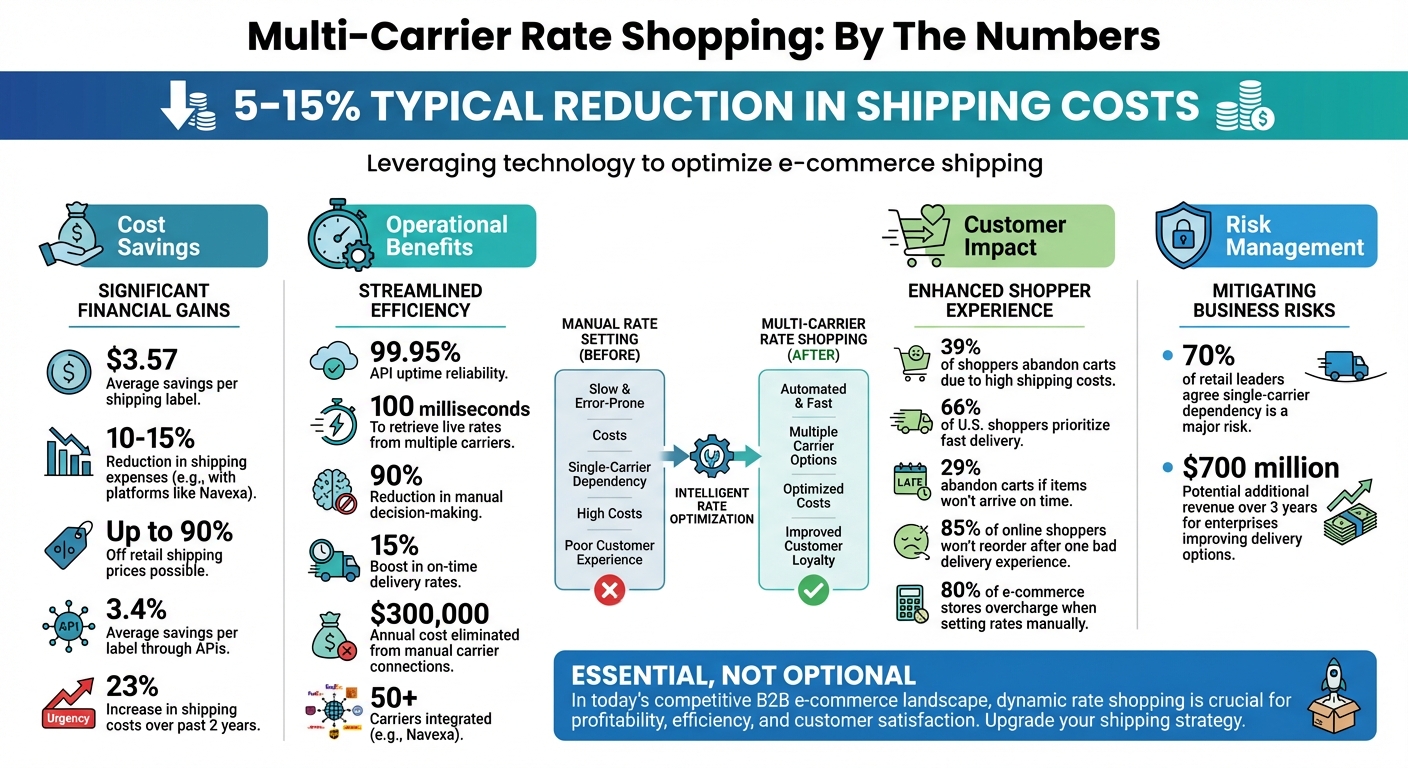
Multi-Carrier Rate Shopping Benefits and Cost Savings Statistics
Multi-carrier Shipping Strategy and Rate Shopping (ft. Nate Skiver)
sbb-itb-ed0a9d1
Core Features of Multi-Carrier Rate Shopping
Multi-carrier rate shopping simplifies carrier selection and helps cut shipping costs by automating the entire process. It relies on three essential features that eliminate the need for manual comparisons, apply your business rules, and seamlessly integrate with your current fulfillment systems.
Real-Time Rate Retrieval and Comparison
When a customer checks out or a warehouse processes an order, the system sends a single API request to multiple carriers - like USPS, FedEx, and UPS - to pull live shipping rates, service options, and transit times all at once. Within just 100 milliseconds, you get a consolidated view of the rates, broken down into components like base costs, fuel surcharges, residential delivery fees, and dimensional weight calculations. This eliminates the hassle of manually checking carrier websites or juggling outdated rate spreadsheets.
The system also provides a detailed breakdown of costs, including fuel charges, confirmation fees, and location-specific surcharges. With APIs boasting 99.95% uptime, businesses can save an average of 3.4% per label and even unlock discounts of up to 90% off retail shipping prices. After gathering the rates, the system uses rule-based adjustments to refine the options. Companies like Navexa use this feature to make smarter shipping decisions.
Rule-Based Rate Adjustment
This feature lets you apply custom business rules to the live rates retrieved. For instance, you can set conditions like hiding air services for packages over 50 lbs., offering free ground shipping for orders over $100, or routing shipments to USPS for PO Box addresses. These rules can combine conditions using "AND" logic (all conditions must be met) or "OR" logic (any one condition must be met). You can also prioritize rules by assigning them processing priorities from 0 to 999.
Common actions include removing certain carriers or services from checkout, adding surcharges for oversized items, offering discounts for specific customer groups, or overriding carrier rates with flat fees for particular zones. Advanced systems can even trigger free shipping once orders hit a specific dollar amount. Pat Sullivan, the Distribution Center & Logistics Manager at Mason Companies, shared that his company recouped their investment in just one month after implementing automated rule-based rate shopping.
Finally, this system integrates seamlessly with your fulfillment workflow, completing the end-to-end process. Navexa uses this feature to fine-tune its shipping strategies.
Fulfillment Workflow Integration
Multi-carrier rate shopping integrates directly with systems like your Order Management System (OMS), Warehouse Management System (WMS), and Transportation Management System (TMS). This integration eliminates manual data entry and the need to toggle between different carrier portals. At checkout, customers see real-time shipping costs and delivery estimates, reducing the likelihood of cart abandonment.
The integration also accounts for practical constraints, such as label creation times and carrier pickup schedules, ensuring delivery promises are realistic. Businesses that adopt integrated rate shopping report a 15% boost in on-time delivery rates and a 90% reduction in manual decision-making. Navexa relies on this feature to streamline its shipping operations and improve efficiency.
Advanced Tools for Cost Optimization
When it comes to reducing shipping expenses, basic rate comparisons are just the beginning. Advanced optimization tools go deeper, addressing hidden costs like dimensional weight fees, inefficient packaging, and unexpected surcharges. These tools build on foundational features, helping businesses achieve greater cost efficiency.
Dimensional Weight and Box Optimization
Shipping carriers often calculate costs based on either the actual weight or the dimensional (DIM) weight of a package - whichever is higher. DIM weight is determined by multiplying a package's length, width, and height, then dividing by a carrier-specific divisor. This means using oversized boxes for lightweight items can lead to paying for empty space, making box optimization critical.
Intelligent box optimization tackles this issue by analyzing packaging choices before labels are created. By matching the box size to the product's dimensions, it minimizes wasted space and reduces DIM weight fees. For example, switching from bulky boxes to cushioned mailers for smaller items can cut both weight and volume while still protecting the product. With shipping costs climbing more than 23% in the past two years, these strategies can save businesses between 5% and 15%.
Shipping Rules and Business Logic
Rule engines allow businesses to automate cost-saving decisions by applying specific conditions to orders. For example, you can set rules to apply surcharges for oversized items or ensure that free shipping is only offered through a designated carrier.
These systems use conditional triggers - such as price, weight, shipping zones, or product attributes - to automate actions that reduce costs. For instance, hazardous goods can be routed away from air carriers, or flat fees can be applied to certain delivery zones. Automating these processes not only eliminates the $300,000 annual cost of manually maintaining carrier connections but also helps combat cart abandonment, as 39% of shoppers abandon their carts due to high shipping costs. This type of logic also enhances dynamic rate adjustments, ensuring a smoother and more efficient fulfillment process.
Real-Time Analytics for Performance Tracking
To manage shipping costs effectively, visibility into key metrics like cost per package, carrier performance, and surcharge trends is essential. Analytics tools track whether carriers meet their delivery promises and highlight patterns in fees such as residential surcharges, fuel adjustments, or address corrections. These insights can reveal when a seemingly low-cost carrier ends up being more expensive than expected.
Platforms like Navexa's real-time analytics continuously monitor these metrics, enabling businesses to adjust their shipping strategies in real time. By normalizing costs - factoring in base rates, fuel surcharges, and discounts - it becomes easier to compare carrier services accurately. This approach ensures that you're not just picking the cheapest rate at checkout but maintaining efficiency across your entire fulfillment process. Considering that approximately 80% of e-commerce stores overcharge for shipping when setting rates manually, analytics-driven automation is a must-have for scaling brands effectively.
Use Cases and Strategies for Dynamic Rate Adjustment
Dynamic rate adjustment helps businesses juggle costs, delivery speed, and customer expectations. Leading e-commerce companies rely on tailored strategies to tackle fulfillment challenges effectively.
Cost-First Shipping Strategies
When profit margins are tight, the key is finding the cheapest shipping option that still meets delivery promises. One standout method is Advanced Date Shopping (ADS), which works backward from the promised delivery date to choose the most economical service. For example, if a customer expects delivery by Friday and the label is created on Tuesday, the system might opt for ground shipping instead of a pricier express option, saving money while meeting the deadline.
To ensure accurate cost comparisons, it’s crucial to account for all charges, including fuel surcharges, residential delivery fees, and accessorial costs. Navexa's platform excels at this by standardizing carrier charges across the board, making it easier to compare rates. It also validates carrier capabilities, ensuring that packages aren’t sent to undeliverable locations, such as PO Boxes for UPS, which helps avoid failed deliveries and unhappy customers.
Timing is another critical factor. For instance, a shipping label created at 4:15 PM might miss a USPS trailer that left at 4:00 PM, forcing you to choose a faster - and more expensive - service to meet the delivery promise. Advanced systems track trailer pull times (when carrier trucks leave your facility) and incorporate this data into rate selection, helping businesses avoid unnecessary costs. Automating these decisions not only saves money but can also improve conversion rates by ensuring reliable delivery.
The next step in fine-tuning shipping strategies involves selecting the best rate based on delivery promises.
Delivery Promise Date Rate Selection
Delivering on promises builds trust, but overspending on faster shipping eats into profits. That’s where Navexa’s delivery promise date selection comes in. Using up to nine data points - like label creation time, transit schedules, and carrier holidays - it identifies the slowest and cheapest shipping option that still meets delivery commitments. This is particularly useful during peak seasons when express shipping costs skyrocket.
The impact on customer satisfaction is undeniable. Studies show that 66% of U.S. shoppers prioritize fast delivery when deciding whether to complete a purchase, and 29% abandon carts if items won’t arrive on time. Even more telling, 85% of online shoppers won’t reorder after a single bad delivery experience. By displaying accurate estimated delivery dates (EDDs) at checkout, powered by real carrier data, businesses can build customer confidence - even when offering slower, more affordable shipping options.
For enterprise companies with annual revenues exceeding $1 billion, improving customer experiences with flexible delivery options can generate an additional $700 million in revenue over three years. As a result, many brands are moving beyond basic "cheapest rate" logic to more advanced algorithms that balance cost with reliability.
While optimizing costs and delivery times is essential, high-value or fragile shipments demand an extra layer of protection.
Risk Management and Insurance Options
Shipping high-value or fragile items requires careful planning. Multi-carrier rate shopping should include shipment insurance to safeguard against loss or damage without defaulting to the most expensive carrier. For example, you might select a regional carrier with a strong reputation for handling fragile electronics and then add third-party insurance, which is often more affordable than upgrading to a premium shipping service.
Diversifying your carrier options is another way to reduce risk. Nearly 70% of retail leaders agree that relying on a single delivery partner poses a major threat to operations. Events like labor strikes, severe weather, or capacity limits during peak seasons can disrupt businesses that depend on one carrier. By working with a mix of national carriers (like UPS and FedEx), regional providers (such as OnTrac and LaserShip), and gig-economy services, you create a safety net that ensures orders keep moving even when one partner faces challenges.
Navexa’s automated workflows, integrated into its platform, simplify this process. If your primary carrier encounters an outage or capacity issue, the system can automatically reroute shipments to a backup provider without manual intervention. This ensures smooth operations while still optimizing costs under normal conditions. Additionally, address verification tools catch errors before labels are printed, reducing the risk of misrouted packages and the customer frustration that follows.
Conclusion and Key Takeaways
For e-commerce businesses grappling with rising shipping expenses - up 23% over the past two years - multi-carrier rate shopping has become a necessity, not a luxury. Automatically comparing shipping rates across carriers helps protect profit margins and keeps businesses competitive in a challenging market.
"Rate shopping isn't an extra feature any longer but a core capability. Brands that invest in it gain the visibility, control, and flexibility they need to stay competitive." - Fidelitone
The numbers speak for themselves: businesses that implement multi-carrier rate shopping typically save between 5% and 15% on shipping costs. On top of that, automated tools can cut an average of $3.57 off each shipping label. For high-volume operations handling thousands of orders daily, these savings quickly become substantial. Beyond cost savings, this strategy also strengthens operations by diversifying carrier options, reducing cart abandonment, and ensuring delivery promises are met - key factors in boosting customer satisfaction.
As highlighted in this guide, Navexa's platform brings together real-time rate comparisons, rule-based automation, dimensional weight optimization, and backup carrier routing. With the ability to process carrier comparisons in under a second and automatically switch to alternative providers during disruptions, Navexa ensures seamless operations while driving down costs. Businesses leveraging this platform often achieve a 10-15% reduction in shipping expenses while streamlining fulfillment processes that can scale as they grow.
Ultimately, turning shipping into a competitive advantage requires balancing cost, speed, and reliability. By mastering multi-carrier rate shopping and staying adaptable to disruptions, businesses can transform shipping from a drain on resources into a strategic strength.
FAQs
How does multi-carrier rate shopping save on shipping costs?
Multi-carrier rate shopping is a smart way to cut shipping costs. It works by automatically comparing shipping rates from multiple carriers in real time, helping you pick the most budget-friendly option that still meets your delivery needs. This ensures you’re not spending more than necessary on shipping.
This approach can save businesses anywhere from 10–15% per shipment while also improving delivery efficiency. By using this tool, companies can simplify their fulfillment process and keep costs in check without sacrificing service quality.
What are the benefits of integrating a fulfillment system with multi-carrier rate shopping?
Integrating a fulfillment system with multi-carrier rate shopping lets businesses compare shipping rates from multiple carriers in real time. This means you can automatically select the most cost-effective shipping option that still meets your delivery needs. The potential savings are impressive - 10%–15% annually. For instance, if your annual shipping spend is $300,000, this could translate to savings of up to $45,000.
But the benefits go beyond just cutting costs. By automating rate selection, this integration reduces manual work for warehouse teams and lowers the risk of errors. It also gives businesses the ability to offer customers more flexible delivery options, such as expedited shipping or Saturday delivery, without driving up expenses. The result? A smoother fulfillment process, happier customers, and stronger loyalty to your brand.
How do custom rules improve multi-carrier rate shopping?
Custom rules turn multi-carrier rate shopping into a powerful strategy by giving merchants the ability to fine-tune shipping options based on specific conditions. These conditions might include factors like the type of product being shipped, the total order value, the delivery destination, or even the type of customer. For instance, merchants can set rules to exclude certain carriers for smaller orders, offer discounts to loyal or premium customers, or add extra charges for items requiring special handling.
These adjustments are applied before rates are compared, allowing businesses to better manage shipping costs while keeping full control over their pricing strategies. Navexa’s platform seamlessly integrates these smart rules into the checkout process, enabling e-commerce brands to cut shipping expenses by 10–15%, all while ensuring a smooth and hassle-free experience for U.S. shoppers.
Ship your next order through Navexa.
Connect a store, buy a label, and see the numbers yourself.