
How Carrier Rate Tools Cut Shipping Costs
Shipping costs can consume 8–15% of an e-commerce business's revenue. Carrier rate tools help reduce these expenses by automating rate comparisons across carriers like USPS, FedEx, and UPS, factoring in hidden fees like fuel surcharges and address correction costs (over $23 per error). These tools save time and money by:
- Providing live rate comparisons in milliseconds.
- Optimizing packaging to minimize dimensional weight fees.
- Validating addresses to avoid correction charges.
- Automating invoice audits to recover billing errors.
Businesses using these tools can save 10–30% on shipping costs, with some mid-sized companies saving up to $150,000 annually. Additionally, features like multi-carrier APIs and automation rules streamline fulfillment while improving delivery accuracy, leading to better customer satisfaction.
For example, Navexa simplifies shipping by connecting carriers, syncing data, and automating workflows, helping brands like Urban Outfitters and Bloom & Wild achieve significant cost reductions and efficiency gains.
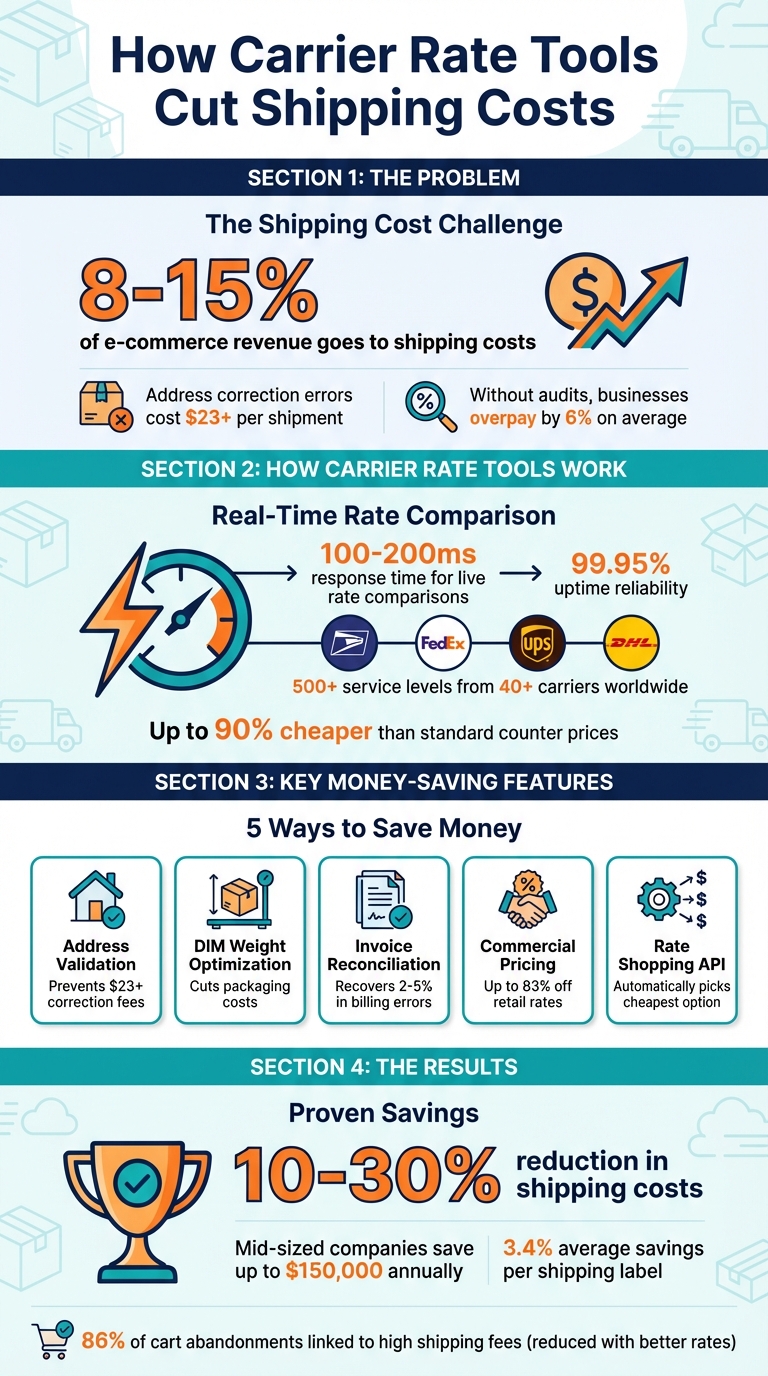
How Carrier Rate Tools Reduce Shipping Costs: Key Statistics and Savings
BEST Shipping Rates Calculator for your Online Store in 2025
sbb-itb-ed0a9d1
How Carrier Rate Tools Work
Carrier rate tools link your business directly to shipping companies using multi-carrier APIs - essentially digital connections to services like USPS, UPS, FedEx, and DHL. Instead of entering package details on each carrier’s website, you input the shipment information once. From there, the tool sends a single API request to all connected carriers, retrieving live rates in just 100ms to 200ms. This integration enables real-time comparisons of shipping options.
Many tools also include address validation, which corrects errors or missing details before fetching rates. This ensures the cost estimate is accurate from the start. Along with standard retail rates, these tools display negotiated rates from your carrier contracts (commonly referred to as "Bring Your Own Account" or BYOA) and discounted commercial rates - sometimes up to 90% cheaper than standard counter prices. Results are typically ranked by "cheapest", "fastest", or "best value", letting you weigh cost, speed, and reliability in one view.
Another key feature is the ability to handle dimensional weight (DIM) pricing. This method considers both the size and weight of a package, and rate tools apply each carrier’s specific DIM factor automatically. This helps avoid overpaying due to inaccurate weight estimates.
These tools are built on high-performance shipping APIs, offering 99.95% uptime and access to over 500 service levels from more than 40 carriers worldwide. For businesses that ship frequently, the time saved and reduced errors translate into an average savings of 3.4% per shipping label.
Real-Time Rate Comparison
The heart of these tools lies in real-time rate comparison. When you're ready to ship, the tool sends your shipment details - such as weight, dimensions, origin and destination zip codes, and service preferences - to multiple carrier systems at once. Each carrier responds with its current service options and pricing, including any surcharges like fuel fees, residential delivery charges, or zone-based pricing. The tool then aggregates all responses into a single view, making it easy to compare prices and delivery times.
Zone mapping is another critical feature. Carriers divide regions into zones based on the distance between the origin and destination, and the tools automatically calculate costs and transit times based on this information. For businesses handling large volumes, many platforms also offer batch rating, allowing you to process thousands of shipments simultaneously.
Data-Driven Decision Making
Beyond comparisons, these tools help businesses make smarter decisions with advanced analytics. Using business rule engines, you can automate shipping choices based on specific priorities. For example, you could set a rule like: "Always choose the cheapest ground option unless the customer selects express shipping." The tool applies these rules automatically for every order.
The algorithms also rank carrier services based on various criteria: "cheapest" for the lowest price, "fastest" for the shortest delivery time, and "best value" for an affordable option that includes delivery within four days and at least $100 in carrier coverage.
Another key feature is carrier invoice reconciliation. After delivery, the tool compares the rate quoted at the time of purchase with the carrier’s final invoice. If discrepancies arise - such as unexpected surcharges, weight adjustments, or zone changes - the tool flags them, enabling you to dispute charges and recover overpayments.
"A shipping API is no longer just an enterprise luxury - it's essential infrastructure for scaling e-commerce brands that want to control costs, streamline operations, and deliver a better customer experience."
- Sobrina Crawford, Shippo
These tools also assist with last-mile optimization, using routing logic to suggest regional carriers for local deliveries. This often results in lower costs and faster delivery times compared to national carriers. By automating decisions and leveraging data, e-commerce brands can consistently lower shipping expenses while maintaining reliable service quality.
Benefits of Using Carrier Rate Tools
Carrier rate tools offer three key advantages for e-commerce businesses: cutting shipping costs, streamlining fulfillment, and delighting customers. Each of these benefits can directly influence your profitability and competitive edge.
Lower Shipping Costs
One of the most immediate perks is saving on shipping expenses. These tools provide access to commercial rates and pre-negotiated discounts, sometimes slashing costs by as much as 83% off standard retail prices. For businesses that have relied on counter rates or single-carrier agreements, these savings can make a massive difference.
Address validation is another money-saver. It prevents costly post-checkout errors, avoiding correction fees that can exceed $23 per shipment. Additionally, packaging optimization helps dodge dimensional weight (DIM) fees by ensuring the smallest suitable box is used, so you’re not paying to ship empty space.
Automated invoice reconciliation is another game-changer. It flags discrepancies between quoted and actual carrier rates, helping you recover overpayments and reduce billing errors. Without such audits, businesses overpay by an average of 6%.
| Feature | How It Saves Money |
|---|---|
| Address Validation | Prevents $23+ per-package correction fees |
| DIM Weight Logic | Cuts costs by optimizing packaging |
| Invoice Reconciliation | Recovers overcharges by identifying billing errors |
| Commercial Pricing | Offers discounts of up to 83% off retail rates |
| Rate Shopping API | Automatically picks the cheapest delivery option |
In short, these tools not only save money but also simplify your shipping process, setting the stage for happier customers.
Improved Fulfillment Efficiency
Lower costs often lead to faster operations. Automation takes over tedious tasks like manual rate shopping, allowing batch processing that can generate thousands of carrier-compliant labels in seconds.
Take Basin Upfitting, for example. In May 2025, this company - known for shipping everything from large commercial equipment to small parts - doubled its output without hiring additional staff. By adopting integrated fulfillment and inventory tools, they streamlined carrier selection and sped up production workflows, leading to faster scaling and better profitability.
For businesses with multiple distribution centers, multi-warehouse routing is another efficiency booster. Orders are automatically sent to the fulfillment center closest to the customer, cutting down on transit time and shipping distance.
Better Customer Satisfaction
Shipping costs are a big deal - 86% of e-commerce cart abandonments are linked to high shipping fees. By showcasing the most affordable rates at checkout, you address one of the main reasons customers leave their carts behind. Real-time rate integration also ensures customers aren’t hit with unexpected surcharges or outdated pricing.
Offering flexible delivery options makes the experience even better. Shoppers can choose between the "cheapest" option for saving money or the "fastest" for urgent needs. This flexibility is critical, as one in four shoppers say the shipping experience shapes at least 50% of their overall shopping journey.
"One of our employees bought something from Banana Republic, and they let her delay shipping at checkout. She was out of town, didn't need it fast - and the option felt like a premium experience."
- Tim Thorn, Shippo
When you make shipping smoother and more affordable, you’re not just saving money - you’re building loyalty and trust with your customers.
How to Set Up Carrier Rate Tools with Navexa
Setting up Navexa is designed to be quick and straightforward. In just a few minutes, you can connect your carriers, sync product data, and set up automation rules. With over 2,500 active brands and more than 50 million packages processed, Navexa has proven its efficiency.
Connect Carrier Accounts
Navexa simplifies linking your carrier accounts with a one-click setup. It supports all major shipping providers - USPS, FedEx, UPS, and DHL - allowing you to compare rates instantly. Plus, it integrates seamlessly with over 50 e-commerce platforms, including Shopify, WooCommerce, and Amazon.
Once your accounts are connected, Navexa's algorithm identifies the best shipping rate based on your chosen priorities, such as cost, speed, or reliability. For example, Urban Outfitters uses Navexa to handle over 10,000 daily orders. Marcus Rodriguez, their VP of Logistics, shared:
"We ship 10,000+ orders daily and Navexa handles it flawlessly. The multi-carrier rate shopping is a game-changer".
By using the one-click setup, you can skip manual API configurations and speed up the onboarding process. After that, make sure to input shipment details accurately to get the most precise rate comparisons.
Input Accurate Shipment Data
To ensure optimal rate comparisons, you'll need to provide key shipment details, including: origin and destination postal codes, package weight and dimensions, and whether the address is residential or commercial. This last detail is crucial, as carriers often charge extra for residential deliveries.
For Navexa's automated box optimization feature to work effectively, you’ll also need to input the exact dimensions and weights of your products. Using advanced 3D bin packing algorithms, the platform selects the best box size to minimize dimensional (DIM) weight fees. Bloom & Wild, for instance, reduced their shipping costs by 12% in the first month of using Navexa. Sarah Chen, their Head of Operations, noted:
"Navexa cut our shipping costs by 12% in the first month. The box optimization alone paid for the entire platform".
| Data Category | Required Input Fields | Why It Matters |
|---|---|---|
| Location Data | Ship From/To Postal Codes, Country Code | Determines carrier shipping zones |
| Package Details | Weight, Length, Width, Height, Package Type | Calculates actual vs. DIM weight |
| Address Type | Residential vs. Commercial Indicator | Identifies delivery surcharges |
| Service Level | Service Class (Economy/Standard/Express) | Sets the base rate for delivery speed |
| Shipment Options | Insurance Value, Confirmation Type | Adds costs for protection and tracking |
Using address validation helps avoid costly correction fees. Once all the data is set, you can configure automation rules to further streamline your shipping processes.
Configure Automation Rules
Navexa's automation rules are designed to make shipping operations more efficient. You can enable multi-carrier rate shopping and link it with box optimization to automatically choose the most cost-effective shipping option while keeping DIM weight fees as low as possible. Additional features like automated label printing and customer notifications help reduce manual work. With 99.9% uptime reliability, Navexa ensures your automation runs smoothly, even during busy seasons.
For businesses handling large volumes, automating inventory forecasting can help maintain steady shipping volumes. This consistency can even improve your ability to negotiate better carrier rates. Glow Recipe, for example, decreased stockouts by 40% using Navexa’s inventory forecasting. Emily Watson, the company’s CEO, shared:
"The inventory forecasting feature helped us reduce stockouts by 40%. Our customers are happier than ever".
Navexa offers a 14-day free trial with no credit card required, giving you a risk-free opportunity to explore its features.
Measuring the Impact of Carrier Rate Tools
Real-Time Analytics and Reporting
Navexa's analytics dashboard offers a clear view of your shipping operations, tracking total costs, delivery times, and carrier performance. It also verifies the 10-15% average savings achieved through multi-carrier rate shopping and box optimization.
By digging into the data, you can identify service-level inefficiencies. For instance, you might be paying for costly air shipping when a more affordable ground service could meet your delivery deadlines. Reviewing zone distribution data can reveal whether ground shipping to nearby zones aligns with your two-day delivery goals - often at a much lower cost than premium air freight. This allows you to shift more shipments to ground services, cutting expenses without compromising customer satisfaction.
Another critical metric is dimensional (DIM) weight penalties. If your billed weight frequently exceeds the actual weight of your packages, you're essentially paying for unused space. Navexa's analytics help you spot these inefficiencies, enabling you to enforce stricter box selection rules and optimize your packaging. Additionally, address validation tools can track and reduce address correction fees, further trimming unnecessary costs.
These insights lay the groundwork for scaling your shipping operations efficiently.
Optimizing for High-Volume Shipping
Once you have real-time data, historical analysis becomes vital for long-term cost control. Navexa processes data from over 50 million packages, offering detailed insights that help high-volume shippers refine their strategies. This includes ensuring carrier agreements are upheld and identifying opportunities for volume-based discounts.
Carrier performance scorecards are another powerful tool. They allow you to measure key metrics like on-time delivery rates (aim for 95% or higher), damage rates (keep below 0.5%), and lost package rates (target under 0.2%). If a carrier consistently falls short, you’ll have the data to negotiate better terms or switch to a more dependable provider.
| Metric Category | Key Performance Indicator | Target/Benchmark |
|---|---|---|
| Cost Efficiency | Blended Cost per Package | $7–$12 (DTC average) |
| Reliability | On-Time Delivery Rate | >95% |
| Quality Control | Damage/Loss Claim Rate | <0.5% |
| Accuracy | Address Correction Incidence | Near 0% (with validation) |
| Packaging Optimization | DIM Weight Penalty | Minimize gap between actual and billed weight |
Automated invoice auditing is another way to save. It can recover 2-5% of your shipping costs by identifying billing errors and service failures. For example, carriers often refund charges for late deliveries, but you need to track and claim these refunds proactively. Considering that shipping expenses typically account for 8-12% of total revenue for direct-to-consumer brands, these optimizations can translate into annual savings of $30,000 to $150,000 for growing businesses.
Conclusion
Shipping costs typically consume between 8–15% of e-commerce revenue. Carrier rate tools simplify this challenge by automating real-time rate comparisons across major carriers like USPS, FedEx, UPS, and DHL. This eliminates guesswork and helps businesses consistently choose the most cost-effective option. Navexa users, for example, see savings through multi-carrier rate shopping and smarter box optimization.
These tools transform fulfillment operations. Automated carrier selection processes orders in seconds instead of minutes, enabling some businesses to ship thousands of packages daily with minimal manual effort. Features like address validation help avoid costly correction fees - now exceeding $23 per shipment - while invoice auditing catches billing errors that can drain profits. These operational upgrades not only cut costs but also improve the customer experience.
The competitive edge extends to customer satisfaction. Automation ensures reliable delivery, a critical factor since 69% of consumers won’t return after a poor delivery experience. Offering multiple delivery options at checkout - from economy to premium express - reduces cart abandonment and meets the expectations of 62% of shoppers who want their orders within three business days.
"Shipping is the hidden profit killer in DTC operations. Most brands accept carrier rates as fixed costs, then watch 8–15% of revenue disappear"
- Marc Wulfraat, President of MWPVL International
With advanced analytics and automation, Navexa turns shipping into a strategic advantage. Businesses can achieve meaningful savings and scale operations effectively through systematic optimization.
Try Navexa’s 14-day free trial to discover how real-time rate shopping, smarter box optimization, and automated workflows can reduce shipping costs and streamline your fulfillment process.
FAQs
What data do I need for accurate real-time shipping rates?
To calculate accurate real-time shipping rates, you’ll need access to live carrier data and detailed package specifics. This includes the weight, dimensions, origin, destination, and the service level you’re using. Having this information allows for precise rate comparisons, helping you make smarter decisions to manage shipping costs effectively.
How do carrier rate tools prevent surprise shipping surcharges?
Carrier rate tools make it easier to avoid unexpected shipping surcharges by comparing real-time rates from different carriers. This helps businesses pick the most cost-effective option while steering clear of surprise fees. Plus, these tools offer clear insights into potential charges, allowing for more precise shipment cost estimates.
How can I measure ROI after turning on rate shopping and box optimization?
To measure ROI effectively, keep an eye on the savings from lower shipping costs and streamlined operations. Focus on metrics like shipment expenses, processing times, and customer satisfaction levels. Tools offered by platforms like Navexa can help you track and quantify these gains, giving you a clearer picture of how strategies like rate shopping and box optimization contribute to your fulfillment process.
Ship your next order through Navexa.
Connect a store, buy a label, and see the numbers yourself.