
How Inventory Forecasting Impacts Peak Season Success
Inventory forecasting is the backbone of thriving during peak shopping seasons like Black Friday and Cyber Monday. Why does it matter? Because these short windows can drive up to 25% of annual revenue for retailers, with U.S. e-commerce sales surpassing $40 billion during the 2025 Black Friday-Cyber Monday period alone. But the stakes are high - stockouts and overstocking cost retailers billions every year.
Here’s the key takeaway: accurate forecasting ensures you have the right stock at the right time, helping you avoid costly errors like running out of inventory or drowning in unsold products post-holiday. Modern AI tools can reduce forecasting errors by 30-50%, giving businesses a competitive edge during these critical periods.
Quick Insights:
- Peak Sales Surge: Order volumes spike 3-10x during events like Black Friday.
- Costs of Poor Planning: Stockouts alone cost U.S. retailers $82 billion annually.
- AI Forecasting Advantage: Modern tools outperform manual methods, cutting errors significantly.
- Safety Stock Buffers: Reserve extra inventory for high-demand SKUs to avoid stockouts.
Accurate forecasting doesn’t just impact inventory - it shapes staffing, supplier coordination, and overall profitability. The brands that succeed during peak season are those that meticulously plan for these surges. Up next, we’ll break down the tools, strategies, and metrics to help you forecast smarter.
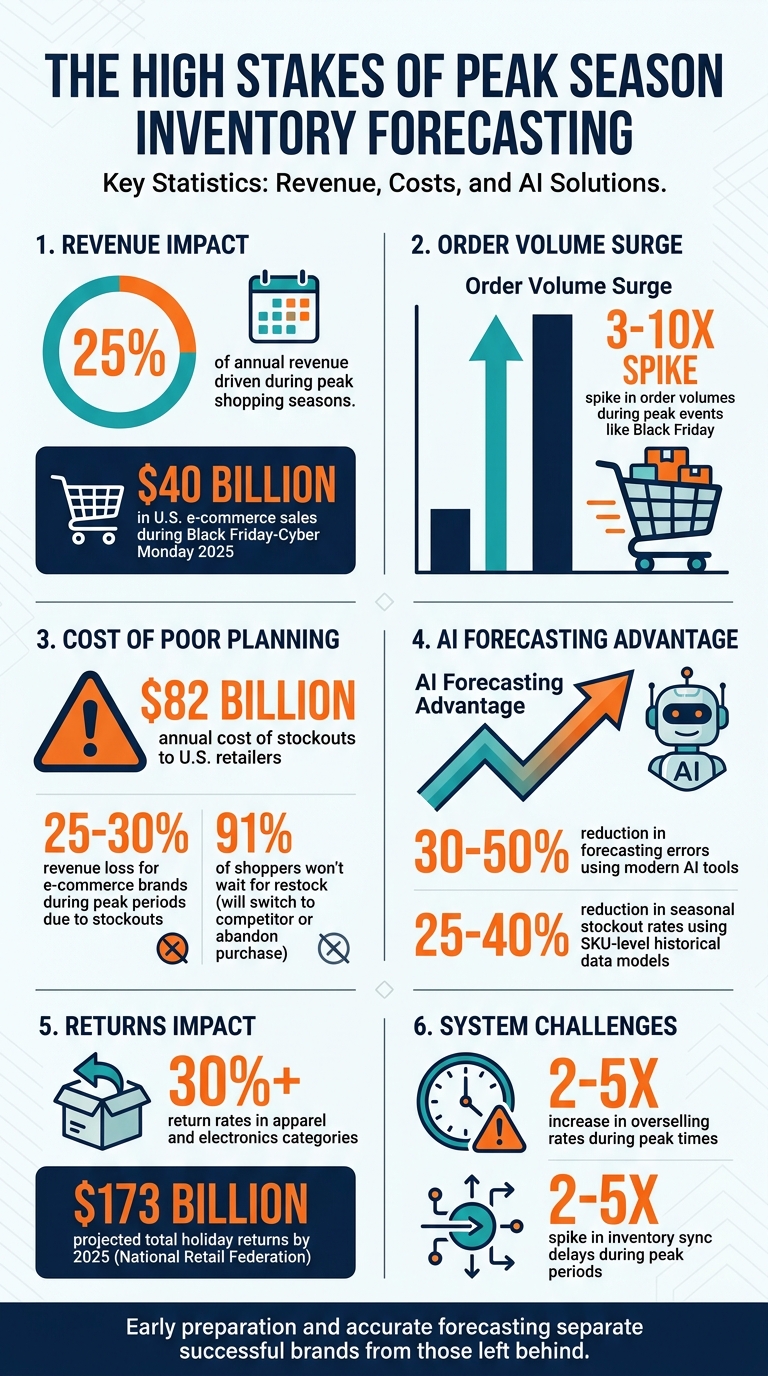
Peak Season Inventory Forecasting Statistics and Impact on E-Commerce Revenue
Key Elements of Accurate Inventory Forecasting
Reviewing Historical Sales Data
When analyzing past sales, it's essential to dig deep into the details - look at the SKU and variant level. Why? Because items like specific sizes, colors, or bundles often behave differently, especially during peak times. For instance, one variant might see a dramatic spike in demand during a major event, even if its overall performance is similar to others.
Equally important is channel-specific analysis. If your Amazon sales grew 35% year-over-year but your Shopify store only grew 20%, applying a single growth rate across the board could lead to overstocking on one platform and understocking on another. The solution? Export and forecast data by channel.
Another key factor is sales velocity - how quickly products move during peak times versus regular periods. For example, a product selling 1,000 units over 30 days behaves very differently from one selling the same amount in just a few peak days. To plan better, calculate the standard deviation of daily demand for your peak periods rather than relying on annual averages. This gives you a clearer picture of how much safety stock you might need.
Don’t forget to account for post-holiday return rates, especially for categories like apparel and electronics, where returns often exceed 30%. Also, inventory sync delays can spike 2–5x during peak times, which can disrupt your planning if not addressed. These patterns are crucial to factor into your forecasts to minimize unexpected costs and customer dissatisfaction.
Once you’ve nailed down your historical insights, it’s time to layer in external factors that could shift demand.
Factoring in Market Trends and External Conditions
Historical data tells you what happened, but external trends and market conditions help predict what’s coming. For example, seasonal indexing can quantify how much demand during a specific period deviates from your baseline. To do this, divide the period’s average by your overall average. Apply this multiplier to your forecast for recurring seasonal shifts. However, keep promotions separate - model their impact independently to avoid inflating organic seasonal demand. Use a formula like: Forecast = Baseline × Seasonal Index × (1 + Promotional Lift).
The timing of peak seasons is also changing. Black Friday, for instance, now often kicks off in October, spreading sales across eight or more weeks instead of one weekend. During this extended period, Amazon tends to grab a bigger share - 20-30% above its usual share - thanks to perks like Prime shipping and Lightning Deals. These shifts in channel performance need to be factored into your planning.
Here’s a quick breakdown of demand types and their timing:
| Demand Type | Examples | Peak Timing |
|---|---|---|
| Holiday-driven | Gifts, toys, electronics | Q4, Valentine's Day |
| Weather-driven | Apparel, outdoor gear | Summer/winter transitions |
| Event-driven | Stationery, fan merchandise | Back-to-school, sports seasons |
| Income-driven | Big-ticket items | Tax refund season, bonus months |
For more advanced forecasting, consider using multiple regression models. These can include factors like advertising spend, weather data, and economic indicators like inflation or interest rates. Instead of relying on a single forecast number, try probabilistic forecasting, which offers a range - like 800–1,200 units at 90% confidence - to account for uncertainties.
Using Real-Time Data for Quick Adjustments
Historical data and market trends set the foundation, but real-time data keeps you agile. Forecasts made months in advance can’t always adapt to rapid changes. For instance, a 15-minute sync delay might seem minor, but during peak events with thousands of daily orders, it could lead to dozens or even hundreds of oversold units.
"A 15-minute sync delay with 200 daily orders means a handful of units might be out of sync... That same 15-minute delay with 2,000 daily orders means dozens or hundreds of units can sell on one channel before the stock deduction reaches another." - Nventory US
Real-time data supports demand sensing, allowing you to adjust plans based on POS velocity, social media trends, or even weather forecasts. This flexibility lets you reallocate inventory between regions or channels, avoiding stockouts in one area while another sits on excess inventory.
During flash sales or promotions, monitor inventory hourly. If stock dips below 20%, reallocate from other channels or end the promotion early to prevent overselling. Before peak season, test your systems by simulating 10x normal webhook volume to ensure they can handle the load without crashing. If real-time sync fails during an event, increase inventory buffers to 25% of listed stock as a safety net.
sbb-itb-ed0a9d1
Sync Up for Success: Tips to Tackle Peak Season
Leveraging inventory forecasting features allows you to maintain optimal stock levels throughout the holiday rush.
Methods for Optimizing Inventory During Peak Seasons
Accurate forecasting is just the start. These strategies ensure your inventory stays resilient during peak demand.
Maintaining Safety Stock Buffers
Safety stock acts as your safety net. To manage this effectively, use a tiered approach based on SKU importance: A-tier products require a 1.3x buffer, B-tier products need a 1.1x buffer, while C-tier products typically don’t require extra stock.
Avoid relying on annual averages for calculating safety stock. Instead, base it on peak demand. For instance, if a product usually sells 100 units weekly but jumps to 500 units during peak times, set your safety stock using the 500-unit figure.
For promotional items like "doorbuster" SKUs, reserve 40% of your inventory specifically for the sale. This ensures these high-demand products remain available throughout the event.
Since lead times often increase during peak seasons due to supplier and carrier overload, add a 15–25% buffer to your lead time estimates. If your inventory systems experience delays during high traffic, consider a manual buffer - list only 75% of your actual stock to avoid overselling.
Stockouts are costly. They can result in a 25–30% revenue loss for e-commerce brands during peak periods. Even worse, 91% of shoppers won’t wait for a restock; they’ll either switch to a competitor or abandon their purchase entirely.
Once your safety stock is secured, the next step is strengthening supplier and logistics partnerships.
Working with Suppliers and Logistics Partners
Peak season preparation starts months ahead. Share your demand forecasts with suppliers 3–4 months in advance to give them time to plan production and allocate resources. Establish clear protocols covering order confirmations, lead time commitments, and policies for handling exceptions or partial shipments.
"Every year, peak season separates the ecommerce brands that planned from the ones that hoped."
- Sarah Jenkins, Nventory US
Place purchase orders at least 90 days before peak events. This accounts for standard 4–8 week lead times and provides an extra 2–4 week buffer. Smaller brands, especially during Q4, risk being deprioritized if they don’t lock in commitments early. If you sell on Amazon, align your schedule with their inbound shipment deadlines, which usually fall 2–3 weeks before major sales events.
For 3PL partners, give detailed weekly order volume forecasts 60 days in advance so they can adjust staffing and carrier pickups accordingly. To maximize efficiency during peak periods, consider staggered warehouse shifts, such as two 8-hour picking shifts starting at 6 AM and 2 PM, to provide 16 hours of continuous coverage.
Relying solely on one supplier or carrier is risky. Identify backup suppliers and carriers to ensure you’re covered if your primary partners face delays. When negotiating MOQs, focus on your total annual purchasing commitments rather than single orders. This prevents tying up capital in slow-moving inventory.
Pair these supplier strategies with advanced technology for sharper forecasting.
Using Technology for Better Forecasting
Manual spreadsheets can’t keep up when order volumes spike 3–10x during peak days. Real-time technology is essential to make quick adjustments and avoid overselling. Overselling rates can increase by 2–5x during peak times due to higher order volumes and potential system delays.
Run a 10x order volume sync test before peak season to identify weak points in your system, such as API failures or queue backups. Brands that skip this step often discover system limitations when it’s already too late.
Accurate forecasting also helps prevent overstocking seasonal items, which can lead to waste and heavy discounting. Models built on SKU-level historical data can cut seasonal stockout rates by 25–40%. Technology also allows you to optimize inventory across channels. For instance, splitting stock between 3PLs and Amazon FBA based on real-time demand can help avoid excessive Q4 FBA storage fees.
Tools like Navexa streamline inventory management by combining forecasting with real-time analytics and automated workflows. These platforms help e-commerce brands maintain optimal stock levels across multiple sales channels while reducing operational headaches. Automated alerts for sync issues or inventory discrepancies can also minimize risks during high-velocity sales events.
Measuring Forecasting Performance and Results
Once you've implemented a forecasting system, the next step is making sure it works. Tracking accuracy is essential for improving performance, especially during peak seasons. Without proper measurement, you won't know where your forecasts succeed - or where they fall short.
Metrics to Track Forecasting Accuracy
Several key metrics help evaluate how well your forecasting system is performing:
- MAPE (Mean Absolute Percentage Error): This measures the average size of forecast errors as a percentage of actual demand. Accuracy targets vary by SKU importance: A-class products should aim for a MAPE below 20%, B-class items under 30%, and C-class products under 40%. During peak seasons, review A-class SKUs weekly, B-class biweekly, and C-class monthly.
- WAPE (Weighted Absolute Percentage Error): When looking at overall portfolio performance, WAPE is a better choice. It weighs errors by actual demand volume, preventing low-volume SKUs from skewing the results.
- Forecast Bias: This reveals whether you're consistently overestimating (leading to excess inventory) or underestimating demand (causing stockouts). To measure bias, divide the cumulative error by the mean absolute deviation. A tracking signal outside the range of +4 to –4 indicates a significant bias that needs correction.
"Forecast accuracy is not a vanity metric. It is the leading indicator that predicts whether your next purchase order will be right-sized or whether you are heading toward a stockout or an overstock event."
- David Vance, Nventory US
- Service-Level Achievement: This tracks the percentage of SKUs that meet their target service levels, ensuring inventory is available when customers need it. It’s the ultimate measure of how well your forecasting supports customer satisfaction.
To get the clearest picture of accuracy, adjust your analysis to account for stockout periods. Sales during these times can make forecasts seem more accurate than they actually are. Removing stockout data ensures a more realistic view of performance.
Improving forecast accuracy by just 10 percentage points - say, reducing MAPE from 30% to 20% - can reduce stockouts by 20% to 35%.
Examples of Improved Peak Season Results
Peak seasons often bring dramatic shifts in demand. For instance, e-commerce sellers may see daily order volumes surge by 3–10 times their normal levels. On the flip side, post-holiday return rates can exceed 30% in categories like apparel and electronics. The National Retail Federation projects total holiday returns to hit $173 billion by 2025. Businesses that account for these return patterns in their forecasts can avoid being left with unsellable inventory in January.
Improving Forecasts Through Post-Season Analysis
After the peak season ends, take time to compare your forecasts to actual sales at the SKU level. Broad category averages won’t give you the full picture - seasonal spikes often affect only your top-performing items.
- Supplier Performance: Review how actual delivery times compared to the lead times used in your planning. If suppliers consistently delivered late, consider adding a 15–25% buffer to next year’s forecasts.
- Promotional Anomalies: Exclude data from one-off promotions like doorbuster events. If your model treats these as organic demand, it could lead to over-forecasting during non-promotional periods.
- Documenting Anomalies: Keep track of unusual events - viral trends, supply chain disruptions, or unexpected competitor actions. This helps separate repeatable patterns from one-off occurrences.
- Post-Mortem Reviews: Hold a meeting with sales, marketing, and supply chain teams to evaluate how promotions impacted inventory levels and identify areas needing better coordination.
Only label demand shifts as "seasonal" if they’ve appeared in at least two historical cycles. This avoids over-investing in inventory based on a single year’s anomaly. By applying these insights, you can refine your forecasting strategies and be better prepared for future peak seasons.
Conclusion: Achieving Peak Season Success with Better Forecasting
Key Insights for E-Commerce Businesses
Succeeding during peak season demands more than just a hefty advertising budget - it requires careful planning and flawless execution. Brands that thrive during this time are those that can handle order surges of 3–10x without faltering.
Start preparing at least 90 days ahead - early September is an ideal time to kick things off. Leveraging probabilistic forecasting models like Holt-Winters can help you predict demand within a range (e.g., 800–1,200 units), rather than relying on a single static number. For your top-performing SKUs, which typically make up 20% of your catalog but drive 80% of revenue, consider using a 1.3x buffer multiplier to safeguard against unexpected demand spikes. Additionally, segment your inventory using ABC classification to apply the right forecasting methods to the right products.
But accurate forecasting isn't just about avoiding stockouts. It also frees up working capital for reinvestment, builds stronger relationships with suppliers through consistent ordering, and enables better workforce planning for busy periods. Advanced forecasting tools are essential to put these strategies into action.
How Platforms Like Navexa Can Help
Traditional spreadsheets simply can't handle the complexity of modern e-commerce. When order volumes jump 3–10x and overselling rates rise by 2–5x, real-time synchronization across multiple sales channels becomes a necessity. Navexa’s all-in-one fulfillment platform is designed to tackle these challenges with features like advanced forecasting, automated workflows, and real-time analytics.
Navexa integrates with over 50 e-commerce platforms, providing centralized visibility to prevent syncing delays. By automating tasks like data entry and inventory replenishment, it reduces errors and allows your team to focus on customer experience and marketing. Plus, its intelligent forecasting features can cut shipping costs by 10–15% while ensuring you have the right products in stock when demand peaks. With tools like this, businesses can approach peak season with confidence and efficiency.
Final Thoughts on Peak Season Readiness
As we've covered, early preparation and precise forecasting are critical for peak season success. This period offers a chance to boost revenue significantly, but it also brings challenges like high return rates and fulfillment bottlenecks.
"Without accurate forecasting, you're essentially flying blind." - Medallion Fulfillment & Logistics
Leveraging technology for forecasting gives you the flexibility to adapt to unexpected supply chain issues, market changes, or demand fluctuations. Make sure to stress-test your systems before the season begins to uncover and fix potential weak spots. Spreading promotions across different channels can help balance fulfillment workloads, while planning for increased staffing - such as doubling picking shifts and tripling customer service coverage - can prepare you for the post-peak surge in inquiries.
Brands that rely on data-driven forecasts, maintain proper inventory buffers, and invest in scalable technology don't just handle the chaos of the season - they turn it into a powerful opportunity to outshine competitors.
FAQs
How far ahead should I start forecasting for peak season?
Start preparing for the peak season about 90 days (or three months) in advance. This gives you the time you need to stock up on inventory, ensure your systems are running smoothly, organize staffing plans, and create backup strategies to manage the surge in demand efficiently.
How do I set safety stock levels for peak-season bestsellers?
When determining safety stock for peak-season bestsellers, focus on demand fluctuations during the peak season rather than relying on annual averages. This approach helps you prepare for sudden demand surges. Include a lead time buffer - typically around 15-25% - to cover potential supplier delays. Use historical sales data to identify trends, account for variability, and set stock levels that balance meeting demand with avoiding excess inventory.
Which forecasting accuracy metric should I track first?
Start by analyzing metrics that highlight how forecast errors influence your business. Key indicators like forecast bias or mean absolute percentage error (MAPE) can provide valuable insights. Zero in on areas where improving accuracy would have the greatest effect - particularly on inventory levels and service performance. Identifying these critical points helps you understand where adjustments can make the most difference.
Ship your next order through Navexa.
Connect a store, buy a label, and see the numbers yourself.